 Back
BackAnatomy & Physiology: Central Nervous System and Brain Structures
 0:50
0:50
Terms in this set (30)
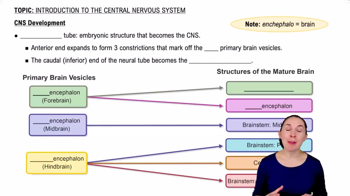
The neural tube's anterior end forms three primary brain vesicles: Prosencephalon (forebrain), Mesencephalon (midbrain), and Rhombencephalon (hindbrain).
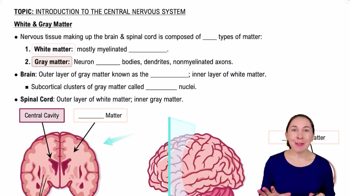
The cerebral hemispheres consist of three main components: cortex (gray matter), white matter, and basal nuclei.
The cerebellum adjusts motor output to ensure coordination and balance for smooth, precise skeletal muscle movements.
The diencephalon includes the thalamus, hypothalamus, and epithalamus, which surround the third ventricle.
The thalamus acts as the relay station for sensory information ascending to the cerebral cortex and participates in sensation, motor activities, arousal, learning, and memory.
The hypothalamus controls the autonomic nervous system, regulates body temperature, food intake, water balance, sleep-wake cycles, and controls the endocrine system.
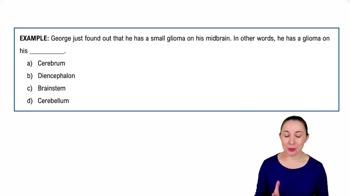
The brain stem consists of three regions: midbrain, pons, and medulla oblongata, organized superior to inferior.
The medulla oblongata controls vital autonomic reflexes including cardiovascular and respiratory centers, and regulates vomiting, coughing, and swallowing.
The cerebral cortex has three types of functional areas: motor areas, sensory areas, and association areas.
Located in the precentral gyrus of the frontal lobe, it controls precise voluntary movements of skeletal muscles via pyramidal cells.
The primary motor cortex has a spatial body map called the motor homunculus, with body parts represented upside down and disproportionally based on motor control precision.
The premotor cortex plans and sequences complex movements, coordinating multiple muscle groups and using sensory feedback.
Broca’s area, usually in the left hemisphere, directs muscles involved in speech production and is active in planning voluntary motor activities.
Located in the postcentral gyrus, it receives sensory input from skin and proprioceptors, enabling spatial discrimination of body regions.
The primary visual cortex processes visual input from the retina, while the visual association area interprets color, form, and movement using past experiences.
The limbic system is involved in emotions, memory, and arousal, linking emotional responses to autonomic functions.
The RAS maintains alertness and consciousness by sending continuous impulses to the cerebral cortex and filtering sensory input.
The BBB consists of tight junctions between capillary endothelial cells, supported by astrocytes, preventing harmful substances from entering the brain and maintaining a stable environment.
CSF is produced by the choroid plexuses in brain ventricles, circulates through ventricles and subarachnoid space, and is absorbed into venous blood via arachnoid granulations.
Key ascending pathways include the dorsal column-medial lemniscal (fine touch, vibration, proprioception), spinothalamic (pain, temperature, crude touch), and spinocerebellar (proprioception for coordination).
Direct pathways originate from pyramidal cells in the motor cortex and control fast, skilled voluntary movements via corticospinal tracts.
Indirect pathways regulate posture, balance, coarse limb movements, and reflexive head, neck, and eye movements through multisynaptic brain stem nuclei.
Most sensory and motor pathways cross over (decussate) to the opposite side of the CNS, resulting in contralateral control of body functions.
Gray matter in the spinal cord forms an 'H' shape with dorsal horns (sensory interneurons), ventral horns (somatic motor neurons), and lateral horns (autonomic motor neurons in thoracic segments).
White matter fibers run in three directions: ascending (sensory to brain), descending (motor from brain), and transverse (commissural fibers connecting sides).
Basal nuclei regulate movement initiation, intensity, and inhibit unwanted movements; involved in motor control, cognition, and emotion.
Parkinson’s disease results from degeneration of dopamine neurons in the substantia nigra, causing tremors, rigidity, slow movement, and shuffling gait.
Alzheimer’s is a progressive brain disease marked by memory loss, confusion, beta-amyloid plaques, neurofibrillary tangles, and neuron death leading to dementia.
The hippocampus is essential for forming new memories and consolidating short-term memory into long-term memory.
Sleep includes NREM (slow-wave sleep with delta waves) and REM (rapid eye movement with beta waves), both essential for restoration and memory processing.