Skip to main content
Anatomy & Physiology
My Course
Learn
Exam Prep
AI Tutor
Study Guides
Textbook Solutions
Flashcards
Explore
Try the app
My Course
Learn
Exam Prep
AI Tutor
Study Guides
Textbook Solutions
Flashcards
Explore
Try the app
Back
Anatomy & Physiology Chapter 3: Cells and Tissues
You can tap to flip the card.
What is the basic structural and functional unit of the human body?
You can tap to flip the card.
👆
What is the basic structural and functional unit of the human body?
The
cell
is the basic structural and functional unit of the human body.
Track progress
Control buttons has been changed to "navigation" mode.
1/23
Recommended videos
Guided course
04:26
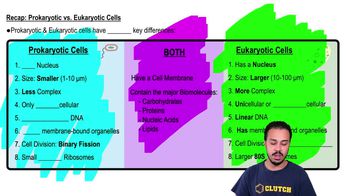
Recap: Prokaryotic vs. Eukaryotic Cells
24084
views
417
rank
Guided course
05:54
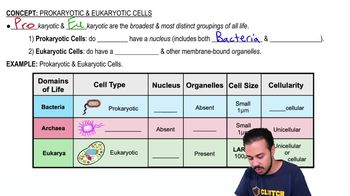
Prokaryotic & Eukaryotic Cells
40178
views
886
rank
2
comments
Guided course
03:54
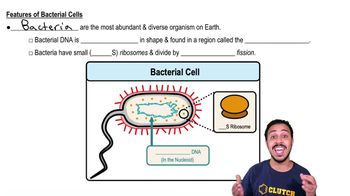
Features of Bacterial Cells
29198
views
519
rank
Terms in this set (23)
Hide definitions
What is the basic structural and functional unit of the human body?
The
cell
is the basic structural and functional unit of the human body.
Name the three main parts of a typical human cell.
The three main parts are the
plasma membrane
,
cytoplasm
, and
nucleus
.
What is the function of the plasma membrane?
The plasma membrane controls the
entry and exit
of substances, maintaining the cell's internal environment.
Describe the fluid mosaic model of the plasma membrane.
The plasma membrane is a
phospholipid bilayer
with embedded proteins that move laterally, creating a flexible and dynamic structure.
What are membrane proteins and their main types?
Membrane proteins include
integral proteins
(embedded) and
peripheral proteins
(attached), serving as receptors, channels, and enzymes.
Define diffusion and its role in cells.
Diffusion
is the passive movement of molecules from high to low concentration, allowing substances to enter or leave cells.
What is osmosis?
Osmosis
is the diffusion of water across a selectively permeable membrane toward a higher solute concentration.
Explain active transport in cells.
Active transport uses
energy (ATP)
to move substances against their concentration gradient via carrier proteins.
What is endocytosis?
Endocytosis is the process by which cells engulf substances by enclosing them in a vesicle formed from the plasma membrane.
Name the three types of endocytosis.
Phagocytosis
(cell eating),
pinocytosis
(cell drinking), and
receptor-mediated endocytosis
.
What is the cytoskeleton?
The cytoskeleton is a network of protein filaments that provide
structural support
, shape, and aid in cell movement.
List the main organelles found in the cytoplasm.
Main organelles include the
mitochondria
,
ribosomes
,
endoplasmic reticulum
,
Golgi apparatus
, and
lysosomes
.
What is the function of mitochondria?
Mitochondria produce
ATP
through cellular respiration, supplying energy for the cell.
Describe the rough endoplasmic reticulum (RER).
The RER has ribosomes on its surface and is involved in
protein synthesis
and modification.
What role does the Golgi apparatus play in the cell?
The Golgi apparatus
modifies, sorts, and packages
proteins and lipids for secretion or delivery within the cell.
Define the nucleus and its function.
The nucleus contains
DNA
and controls cell activities by regulating gene expression.
What is the cell cycle?
The cell cycle is the series of events leading to cell division, including
interphase
and
mitosis
.
Name the phases of mitosis.
Phases are
prophase
,
metaphase
,
anaphase
, and
telophase
.
What is apoptosis?
Apoptosis
is programmed cell death, a controlled process to remove damaged or unnecessary cells.
Define epithelial tissue.
Epithelial tissue covers body surfaces and lines cavities, providing protection, absorption, and secretion.
What are the main types of connective tissue?
Connective tissue types include
loose connective
,
dense connective
,
cartilage
,
bone
, and
blood
.
Describe muscle tissue types.
Muscle tissue types are
skeletal
(voluntary),
cardiac
(heart), and
smooth
(involuntary).
What is the function of nervous tissue?
Nervous tissue transmits electrical impulses to coordinate body functions.
 BackBack
 04:26