 Back
BackAnatomy & Physiology: Chapter 4 - Tissues
 03:32
03:32
Terms in this set (21)
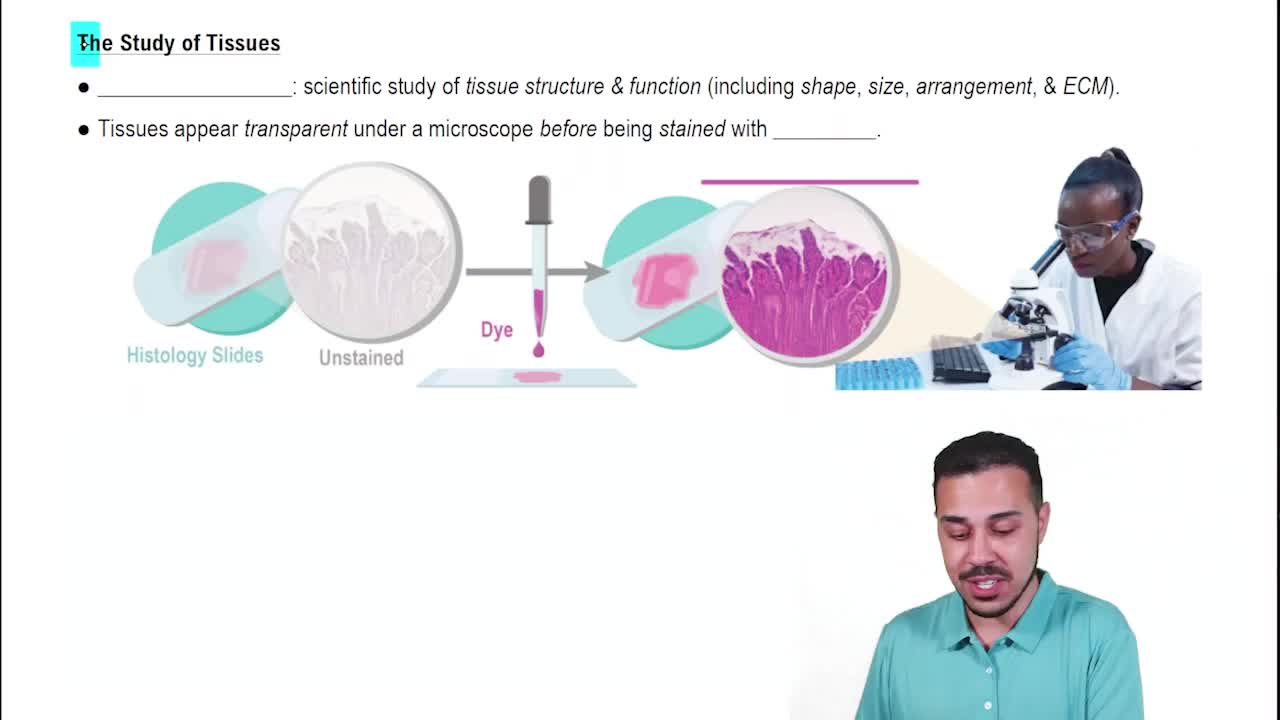
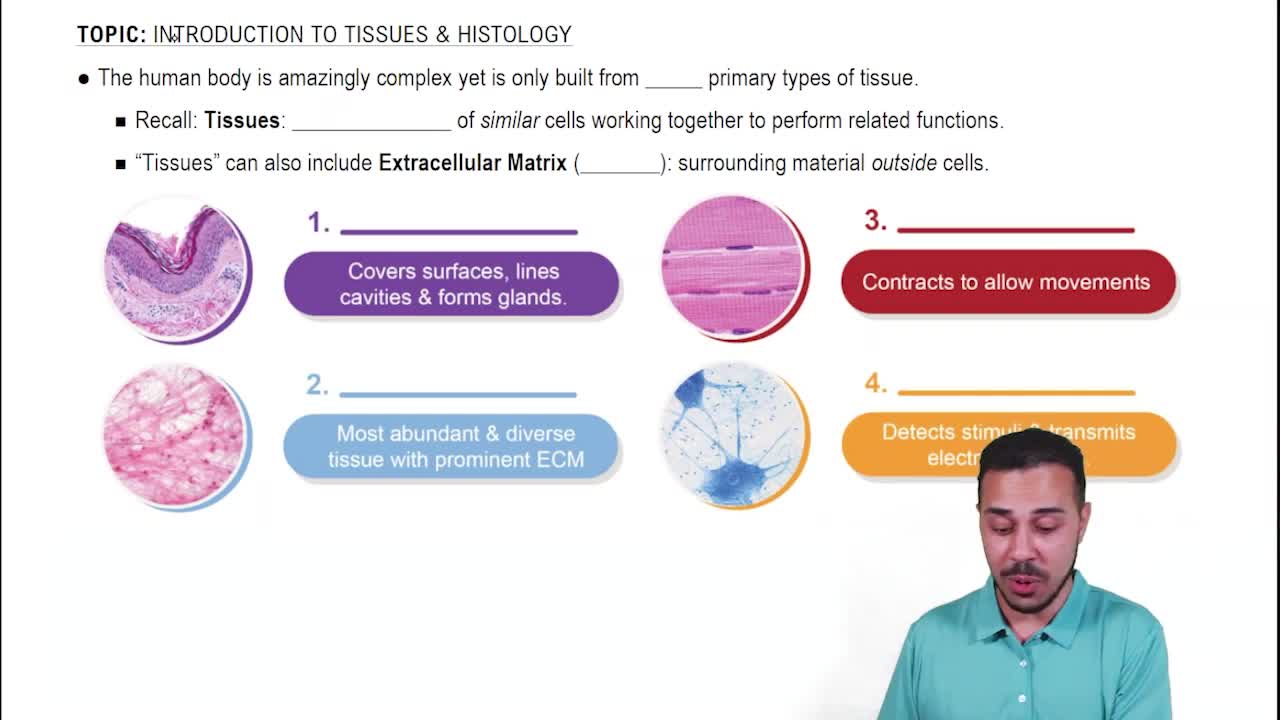
A tissue is a group of cells with similar structure that performs a common function and may contain nonliving extracellular matrix.
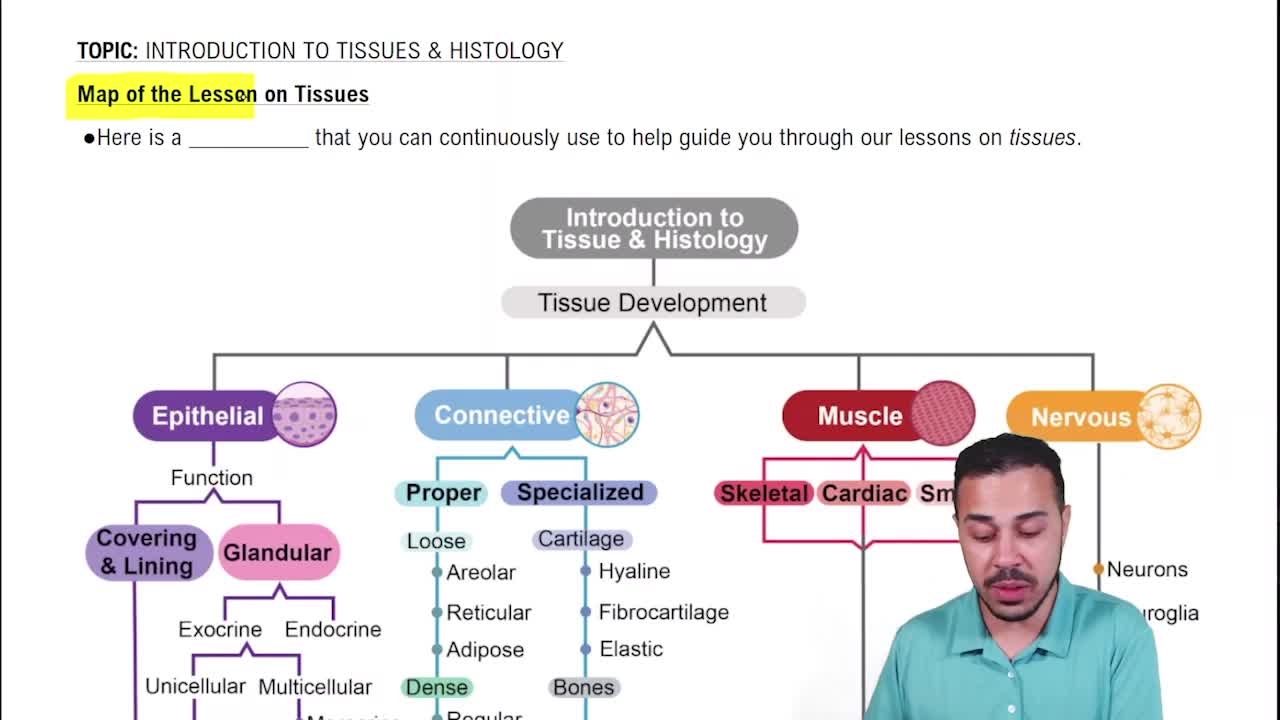
Epithelial: covering, lining, glands.
Connective: support, binding, protection.
Muscle: movement.
Nervous: control and communication.
Thin tissue favors diffusion or filtration; many layers favor protection; parallel collagen resists pull in one direction; irregular collagen resists tension from multiple directions.
Cellularity: tightly packed cells.
Specialized contacts: cell junctions.
Polarity: apical and basal surfaces differ.
Connective-tissue support: basement membrane.
Avascular but innervated.
Regeneration: rapid cell division.
Simple: one layer, all cells touch basement membrane.
Stratified: two or more layers, only basal cells touch basement membrane.
Squamous: wider than tall, flat nuclei.
Cuboidal: as wide as tall, round nuclei.
Columnar: taller than wide, oval nuclei near basal surface.
All cells contact basement membrane but nuclei appear at different heights, creating a false multilayered look; often ciliated with goblet cells.
One thin layer with flat nuclei; functions in diffusion, filtration, and lubrication; found in alveoli, kidney glomeruli, blood vessels, and serous membranes.
Keratinized: dead surface cells filled with keratin, waterproof and abrasion resistant (epidermis).
Nonkeratinized: living moist surface cells, protect moist openings (mouth, esophagus).
Cells separated by abundant extracellular matrix; matrix composition and fiber arrangement determine mechanical properties.
Collagen: tensile strength.
Elastic fibers: stretch and recoil.
Reticular fibers: supportive networks.
Adipose: energy reserve, insulation.
Reticular: supportive stroma.
Dense regular: tensile strength in one direction.
Dense irregular: resists tension multidirectionally.
Elastic: stretch and recoil.
Firm, flexible, up to 80% water matrix; avascular; chondroblasts secrete matrix; mature chondrocytes in lacunae.
Hyaline: glassy matrix, support and cushioning.
Elastic: visible elastic fibers, flexible support.
Fibrocartilage: thick collagen bundles, tensile strength and shock absorption.
Mineralized matrix with calcium salts and collagen; osteoblasts secrete matrix; osteocytes in lacunae; well vascularized; provides rigid support and mineral storage.
Cells suspended in fluid extracellular matrix; transports gases, nutrients, and wastes; located within blood vessels.
Skeletal: long, cylindrical, multinucleate, striated, voluntary.
Cardiac: short, branching, usually one nucleus, striated, involuntary, intercalated discs.
Smooth: spindle-shaped, one nucleus, nonstriated, involuntary.
Skeletal: many peripheral nuclei + striations.
Cardiac: branching striated cells + intercalated discs.
Smooth: spindle-shaped cells, no striations.
Neurons: generate and conduct nerve impulses.
Neuroglia: nourish, insulate, and protect neurons.
Most combine an epithelial sheet with underlying connective tissue to cover internal or external surfaces.
Cutaneous: keratinized stratified squamous epithelium + connective tissue (skin).
Mucous: epithelium + lamina propria, lines organs opening to body surface.
Serous: simple squamous mesothelium + areolar connective tissue, lines closed cavities.