Skip to main content
Anatomy & Physiology
My Course
Learn
Exam Prep
AI Tutor
Study Guides
Textbook Solutions
Flashcards
Explore
Try the app
My Course
Learn
Exam Prep
AI Tutor
Study Guides
Textbook Solutions
Flashcards
Explore
Try the app
Back
Anatomy & Physiology: Digestive and Respiratory Systems
You can tap to flip the card.
What accessory organ is NOT part of the digestive system?
You can tap to flip the card.
👆
What accessory organ is NOT part of the digestive system?
Spleen
is not an accessory organ of the digestive system.
Track progress
Control buttons has been changed to "navigation" mode.
1/30
Recommended videos
4:06
Introduction to the Digestive System Example 2
6019
views
110
rank
5:08
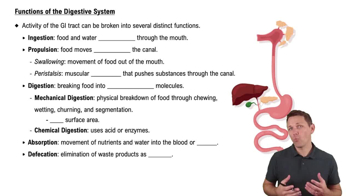
Functions of the Digestive System
6964
views
149
rank
6:28
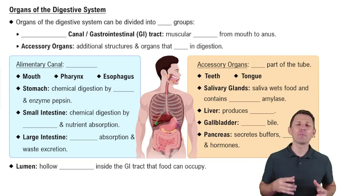
Organs of the Digestive System
10333
views
307
rank
1
comments
Terms in this set (30)
Hide definitions
What accessory organ is NOT part of the digestive system?
Spleen
is not an accessory organ of the digestive system.
Which vitamins do bile salts aid in absorbing?
Bile salts aid the absorption of
fat soluble vitamins
.
What does the root canal of a tooth contain?
The root canal contains
blood vessels and nerves
.
What type of epithelial cells line the small intestine?
The small intestine is lined by
simple columnar epithelial cells
.
What do chief cells of gastric glands secrete?
Chief cells secrete
protein digesting enzymes
.
Which is NOT a salivary gland?
Fungiform
is not a salivary gland; it is a type of papilla on the tongue.
Normal glucose level in blood per 100 ml is?
Normal glucose level is
80-100 milligrams
per 100 ml of blood.
Which cells secrete hydrochloric acid and intrinsic factor?
Parietal cells
secrete hydrochloric acid and intrinsic factor.
Intrinsic factor facilitates absorption of which vitamin?
Intrinsic factor facilitates absorption of
vitamin B12
.
What is the mixture of gastric juice and food called?
The mixture is called
chyme
.
Which part is NOT part of the stomach?
Duodenum
is not part of the stomach; it is the first part of the small intestine.
What are the ridges and folds inside the stomach called?
They are called
rugae
.
When does the gastric phase of stomach function begin?
It begins
with the arrival of food in the stomach
.
What is the function of bile in digestion?
Bile emulsifies
lipids
to aid digestion.
What is the functional unit of the liver?
The functional unit is the
hepatic lobule
.
What stores and concentrates bile?
The
gall bladder
stores and concentrates bile.
Where does the portal vein first empty blood collected from the digestive tract?
It empties into the
liver
.
What type of blood does the portal vein carry?
It carries blood
rich in digested food molecules but poor in oxygen
.
Where does most absorption of digested food occur?
Absorption mainly occurs in the
small intestine
.
Where do the common bile duct and pancreatic duct empty?
They empty into the
duodenum
.
Which function is NOT performed by the liver?
The liver does NOT secrete
hydrochloric acid
.
What are the digestive functions of saliva?
Saliva splits starch and glycogen, binds food particles, acts as a lubricant, and dissolves food chemicals.
What are the main components of bile?
Bile contains
water, bile salts, bile pigments, cholesterol, and electrolytes
.
In which layer of the alimentary canal does absorption occur?
Absorption occurs in the
mucosa
layer.
What are the main functions of the large intestine?
Absorption of water and electrolytes, and synthesis of certain vitamins.
How long is the small intestine approximately?
The small intestine is about
20 feet
long.
What increases the surface area for absorption in the small intestine?
The presence of
villi
increases surface area.
What guards the passage between the ileum and cecum?
The
ileocecal valve
guards this passage.
Where does carbohydrate digestion begin?
Carbohydrate digestion begins in the
mouth
.
How do digested fatty acids enter the circulatory system?
They diffuse into
intestinal lacteals
(lymphatic vessels).
 BackBack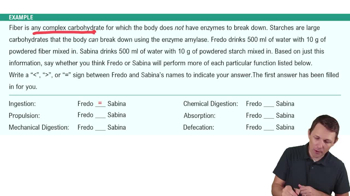
 4:06
4:06