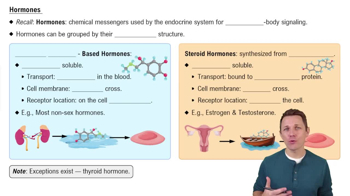
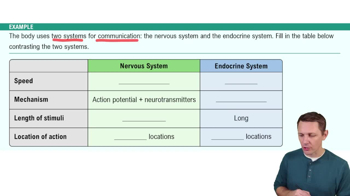
The endocrine system regulates body functions by releasing hormones that act as chemical messengers to target cells.
Function of endocrine glands
Endocrine glands secrete hormones directly into the bloodstream to regulate various physiological processes.
Pure endocrine organs vs neuroendocrine glands
Pure endocrine organs only secrete hormones (e.g., thyroid), while neuroendocrine glands release hormones and have neural functions (e.g., hypothalamus).
Examples of organs with endocrine tissue and limited endocrine function
Organs with endocrine tissue include the pancreas and gonads; organs with limited endocrine function include the heart and kidneys.
Changes hormones cause in the body
Hormones can alter metabolism, growth, development, mood, and homeostasis.
Definition of target cell
A target cell has specific receptors for a hormone and responds to its signal.
Regulation of target cell activation
Target cell activation is regulated by hormone concentration, receptor number, and receptor affinity.
How small hormone amounts have big effects
Hormones act via amplification cascades inside cells, so small amounts trigger large responses.
Duration of hormone effects
Hormone effects can last from seconds to hours or days depending on hormone type and target cell.
Three ways the body regulates hormone release
Hormone release is regulated by humoral stimuli (blood levels), neural stimuli (nerve signals), and hormonal stimuli (other hormones).
Difference between anterior and posterior pituitary
The anterior pituitary produces and releases hormones; the posterior pituitary stores and releases hormones made by the hypothalamus.
Hormones of the pituitary gland
The pituitary secretes 8 hormones including GH, ACTH, TSH, LH, FSH, PRL, ADH, and oxytocin.
Regulation of pituitary hormones
Pituitary hormones are regulated by hypothalamic releasing/inhibiting hormones and feedback from target organs.
Diseases from abnormal pituitary secretion
Examples include gigantism (excess GH), dwarfism (deficient GH), and diabetes insipidus (ADH deficiency).
Hormones of the thyroid gland
The thyroid produces thyroxine (T4), triiodothyronine (T3), and calcitonin.
Effect of thyroid hormones
Thyroid hormones regulate metabolism, growth, and development.
Regulation of thyroid hormone secretion
Thyroid hormone release is controlled by TSH from the anterior pituitary via negative feedback.
 Back
Back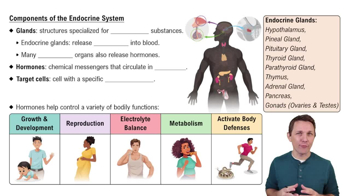
 7:06
7:06