 Back
Anatomy & Physiology: Endocrine and Cardiovascular System Physiology
 7:06

Terms in this set (13)
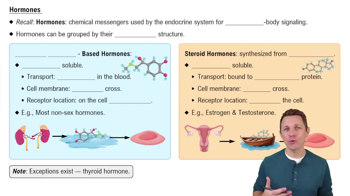
Amino acid hormones are water-soluble and act on membrane receptors; steroid hormones are lipid-soluble and act on intracellular receptors.
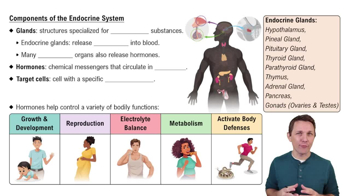
The hypothalamus controls the pituitary gland by releasing hormones that regulate pituitary hormone secretion.
The anterior pituitary produces and releases hormones under hypothalamic control; the posterior pituitary stores and releases hormones made by the hypothalamus.
Multi-tiered feedback involves multiple glands where hormones from one gland regulate another, with negative feedback loops controlling hormone levels.
The pancreas regulates blood glucose by releasing insulin to lower and glucagon to raise blood sugar levels.
The pulmonary circuit moves blood between heart and lungs; the systemic circuit moves blood between heart and body tissues.
Blood flows: body → right atrium → right ventricle → lungs → left atrium → left ventricle → body.
Coronary circulation supplies the heart muscle with oxygen; blockage can cause ischemia or heart attack.
Pacemaker cells depolarize spontaneously due to slow Na+ influx, Ca2+ influx, and K+ efflux, generating rhythmic impulses.
P wave: atrial depolarization; QRS complex: ventricular depolarization; T wave: ventricular repolarization.
The cardiac cycle includes atrial systole, ventricular systole, and diastole phases coordinating heart contraction and relaxation.
Cardiac output is the volume of blood pumped per minute, calculated as heart rate × stroke volume.
Cardiac output is controlled by autonomic nervous system input, venous return, and hormonal signals.