 Back
Anatomy & Physiology: Endocrine System and Blood Study Guide
 7:06

Terms in this set (46)
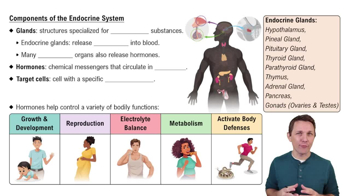
Hormones are chemical messengers produced by endocrine glands that regulate body functions.
A target tissue is a tissue affected by a hormone; a receptor is a protein on or in target cells that binds the hormone.
The pancreas produces both endocrine (hormones) and exocrine (digestive enzymes) products. The hypothalamus is part of the nervous system and produces hormones.
Homeostasis is the maintenance of a stable internal environment despite external changes.
Negative feedback is a control mechanism where a hormone's effect reduces its own production to maintain balance.
Biorhythm is a cyclic pattern of hormone release; examples include daily cortisol, monthly estrogen, and seasonal melatonin rhythms.
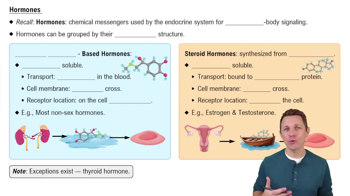
Hormones are classified as amino acid derivatives, peptides/glycoproteins, and steroids, differing in structure and solubility.
Hydrophobic hormones (steroids) are lipid-soluble, bind intracellular receptors, and use direct gene activation. Hydrophilic hormones (peptides) are water-soluble, bind surface receptors, and use second messengers.
Direct gene activation is used by hydrophobic hormones binding intracellular receptors to alter gene expression. Second messengers are used by hydrophilic hormones binding surface receptors to activate signaling cascades.
Upregulation increases receptor numbers to enhance sensitivity; downregulation decreases receptors to reduce sensitivity.
Free hormones circulate unbound and are usually hydrophilic. Bound hormones are attached to transport proteins, typically hydrophobic steroids, increasing their half-life.
Permissiveness: one hormone enables another's effect. Synergism: hormones amplify each other's effects. Antagonism: hormones oppose each other's effects.
Humoral: changes in blood chemistry; Neural: nervous system signals; Hormonal: hormones stimulate other hormones.
The hypothalamus is above the pituitary; it controls the anterior pituitary (adenohypophysis) via releasing/inhibiting hormones and the posterior pituitary (neurohypophysis) stores hormones made by hypothalamic neurosecretory cells.
Neurosecretory cells in hypothalamus produce oxytocin and antidiuretic hormone (ADH), stored and released by the posterior pituitary.
Neurohypophysis stores/releases hypothalamic hormones (ADH, oxytocin). Adenohypophysis synthesizes and secretes its own hormones under hypothalamic control.
Tropic hormones stimulate other endocrine glands. Examples: hypothalamic TRH, CRH, GnRH; anterior pituitary TSH, ACTH, FSH, LH.
TSH is produced by the anterior pituitary; stimulated by hypothalamic TRH; it stimulates the thyroid gland to produce thyroid hormones.
ACTH is produced by the anterior pituitary; stimulated by hypothalamic CRH; it stimulates the adrenal cortex to release glucocorticoids.
Produced by anterior pituitary; stimulated by hypothalamic GnRH; FSH promotes gamete production; LH triggers sex hormone production and ovulation.
Produced by anterior pituitary; stimulated by GHRH and inhibited by GHIH from hypothalamus; GH promotes growth directly and indirectly via somatomedins from liver.
Produced by anterior pituitary; stimulated by PRH and inhibited by PIH; PRL targets mammary glands to promote milk production.
The thyroid gland is in the neck; it produces thyroid hormone (T3 and T4) regulating metabolism and calcitonin regulating blood calcium.
Follicles are spherical units producing thyroid hormone; colloid is stored hormone precursor inside follicles.
Parafollicular cells are in thyroid gland; they produce calcitonin, which lowers blood calcium.
T3 and T4 increase metabolic rate; synthesized from iodine and tyrosine; regulated by hypothalamic TRH and pituitary TSH via negative feedback.
Calcitonin lowers blood calcium by inhibiting osteoclasts, stimulating osteoblasts, and increasing kidney calcium excretion; released when blood calcium is high.
Located on thyroid's posterior surface; produce parathyroid hormone (PTH) which raises blood calcium levels.
PTH increases blood calcium by stimulating osteoclasts, reducing kidney excretion, and enhancing intestinal absorption; released when calcium is low.
Exocrine pancreas produces digestive enzymes; endocrine pancreas (islets) produces hormones like insulin and glucagon regulating blood glucose.
Glucagon raises blood glucose by stimulating glycogenolysis and gluconeogenesis; released when blood glucose is low.
Insulin lowers blood glucose by promoting glycogenesis and glucose uptake into insulin-dependent cells; released when blood glucose is high.
Located above kidneys; adrenal cortex produces steroid hormones (glucocorticoids, mineralocorticoids); adrenal medulla produces catecholamines (epinephrine, norepinephrine).
Triggered by adrenal medulla hormones; prepares body for stress by increasing heart rate, blood flow, and energy availability.
Glucocorticoids (e.g., cortisol) regulate metabolism and suppress inflammation; mineralocorticoids (e.g., aldosterone) regulate sodium and water balance.
Aldosterone release is stimulated by ACTH and the renin-angiotensin system in response to low blood pressure or sodium.
Female gonads are ovaries producing estrogen and progesterone; male gonads are testes producing testosterone.
The pineal gland is in the brain; it produces melatonin, which regulates circadian rhythms.
Hematocrit is the percentage of blood volume occupied by red blood cells.
Formed elements include erythrocytes (RBCs), leukocytes (WBCs), and platelets.
Erythrocytes transport oxygen bound to hemoglobin from lungs to tissues.
Leukocytosis is an elevated white blood cell count; leukopenia is a decreased white blood cell count.
Hemostasis is the process that stops bleeding via vascular spasm, platelet plug formation, and coagulation.
A thrombus is a stationary blood clot; an embolus is a clot or debris that travels through the bloodstream.
ABO blood groups are determined by the presence or absence of specific surface antigens on red blood cells and corresponding antibodies in plasma.
It occurs when an Rh-negative mother produces antibodies against Rh-positive fetal blood; prevented by administering Rh immunoglobulin to the mother.