 Back
BackAnatomy & Physiology: Endocrine System, Blood, and Cardiovascular System Study Guide
 7:06
7:06
Terms in this set (37)
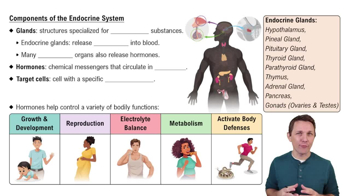
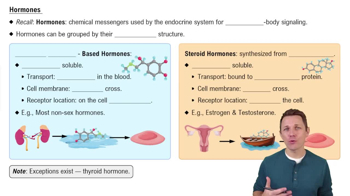
Hormones are chemical messengers secreted by endocrine glands that regulate various body functions by acting on target cells.
Endocrinology is the study of hormones, the endocrine glands that produce them, and their effects on the body.
Target cells are cells that have specific receptors for a hormone and respond to its presence.
Hormones control growth, metabolism, reproduction, fluid and electrolyte balance, and stress responses.
Exocrine glands secrete substances through ducts to body surfaces or cavities; endocrine glands release hormones directly into the bloodstream. Five major endocrine glands: pituitary, thyroid, parathyroid, adrenal, and pineal.
The hypothalamus is a neuroendocrine organ that links the nervous and endocrine systems by producing hormones that regulate the pituitary gland.
Autocrines act on the same cell that secretes them; paracrines act on nearby cells without entering the bloodstream.
Hormones alter membrane permeability, stimulate protein synthesis, activate/deactivate enzymes, induce secretion, and stimulate mitosis.
Humoral stimulus triggers hormone release in response to changing blood levels of ions or nutrients, e.g., low blood calcium stimulates parathyroid hormone release.
Neural stimulus involves nerve fibers stimulating hormone release, e.g., sympathetic nervous system triggers adrenal medulla to release epinephrine.
Hormonal stimulus occurs when hormones stimulate other endocrine glands to release hormones, e.g., hypothalamic hormones stimulate the anterior pituitary.
Up-regulation: target cells increase receptors due to low hormone levels. Down-regulation: target cells decrease receptors after prolonged high hormone exposure.
The half-life is the time it takes for half the hormone to be removed from the blood.
Permissiveness occurs when one hormone enhances the target organ's response to a second hormone.
Synergism is when two hormones produce the same effect and their combined effect is greater than the sum of individual effects.
Antagonism occurs when one hormone opposes the action of another.
The adrenal cortex produces mineralocorticoids, glucocorticoids, and androgens.
The adrenal medulla synthesizes epinephrine and norepinephrine.
Glucagon raises blood glucose by stimulating glycogen breakdown; insulin lowers blood glucose by promoting uptake and storage.
Insulin lowers blood glucose by stimulating glucose uptake by cells, promoting glycogen formation, and inhibiting glucose release by the liver.
Blood is a connective tissue that transports nutrients, gases, wastes, hormones, and helps regulate body temperature and immunity.
Formed elements include erythrocytes (red blood cells), leukocytes (white blood cells), and platelets (cell fragments).
Erythrocytes are biconcave, lack nucleus and organelles, and transport oxygen and carbon dioxide.
Hematopoiesis is the process of blood cell formation occurring in red bone marrow.
Anemia is a deficiency of red blood cells or hemoglobin; polycythemia is an excess of red blood cells.
Leukocytes are white blood cells involved in immunity; major categories are granulocytes (neutrophils, eosinophils, basophils) and agranulocytes (lymphocytes, monocytes).
Hemostasis is the process that stops bleeding through vascular spasm, platelet plug formation, and coagulation.
Whole blood transfusion replaces blood volume and cells; packed red blood cells transfusion replaces only red blood cells.
ABO blood groups are determined by alleles of the I gene encoding enzymes that add specific sugar antigens to red blood cells.
Agglutinogens are antigens on red blood cells; agglutinins are antibodies in plasma that react against foreign agglutinogens.
The pulmonary circuit carries blood between the heart and lungs; the systemic circuit carries blood between the heart and the rest of the body.
The heart wall layers are epicardium (outer), myocardium (muscle), and endocardium (inner lining).
AV valves prevent backflow into atria during ventricular contraction; SL valves prevent backflow into ventricles after blood is ejected.
Angina pectoris is chest pain caused by reduced blood flow to heart muscle.
Myocardial infarction or heart attack is death of heart muscle due to prolonged lack of blood supply.
Intercalated discs are specialized connections between cardiac muscle cells containing desmosomes and gap junctions for mechanical and electrical coupling.
The pacemaker cells in the sinoatrial (SA) node initiate the heart's rhythmic action potentials.