 Back
Anatomy & Physiology: Endocrine System Key Concepts
 7:06

Terms in this set (28)
Enter the blood and act on target cells that may be far away. Examples include insulin, thyroid hormones, and cortisol.
Act on neighboring cells near the release site. Examples include histamine and many prostaglandins.
Act on the same cell that released the signal. Examples include some growth factors and cytokines.
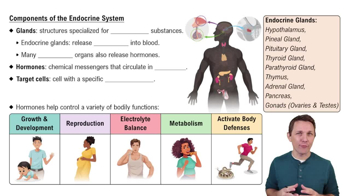
Hypothalamus, pituitary gland, and pineal gland.
Peptides/proteins, steroids, amino acid-derived hormones (amines), and eicosanoids.
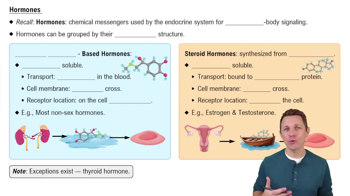
Made of amino acid chains, water-soluble, circulate freely in plasma, bind to cell-surface receptors, and activate intracellular signaling.
Derived from cholesterol, lipid-soluble, travel bound to carrier proteins, bind intracellular receptors, and regulate gene transcription.
Catecholamines (epinephrine, norepinephrine), thyroid hormones (T3, T4), and melatonin.
Derived from 20-carbon fatty acids, act locally via paracrine or autocrine signaling, regulate inflammation and smooth muscle activity.
Used by water-soluble hormones; hormone binds membrane receptor, activates second messengers like cAMP, leading to rapid cellular responses.
Used by lipid-soluble hormones; hormone enters cell, binds receptor in cytoplasm or nucleus, alters gene transcription, causing slower but longer-lasting effects.
Humoral (changes in blood ions/nutrients), neural (nerve signals), and hormonal (hormones stimulating other glands).
The response reduces the original stimulus to limit further hormone release, maintaining homeostasis.
The response intensifies the original stimulus, increasing hormone release until a specific event ends the cycle (e.g., childbirth).
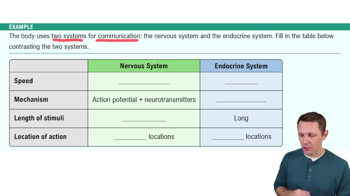
Neural control is fast, targeted, uses electrical impulses; hormonal control is slower, widespread, uses blood-borne chemical messengers.
Produces releasing/inhibiting hormones regulating anterior pituitary; also produces ADH and oxytocin.
GH (growth), TSH (thyroid stimulation), ACTH (adrenal cortex stimulation), FSH (follicle/sperm development), LH (ovulation/testosterone), prolactin (milk production).
Stores and releases ADH (water conservation) and oxytocin (uterine contractions, milk ejection), both produced by hypothalamus.
T3 and T4 regulate metabolic rate and development; calcitonin lowers blood calcium but has minor adult role.
Raises blood calcium levels; secreted by parathyroid glands located on the posterior thyroid.
Aldosterone regulates sodium/potassium balance; cortisol regulates metabolism and stress response; adrenal androgens contribute to secondary sex characteristics.
Epinephrine and norepinephrine support the fight-or-flight response.
Insulin lowers blood glucose; glucagon raises blood glucose; somatostatin regulates islet hormone secretion.
Estrogens and progesterone regulate reproduction and pregnancy; inhibin regulates FSH secretion.
Testosterone supports male reproduction and secondary sex characteristics; inhibin regulates FSH and sperm production.
Receives neural input and regulates pituitary hormone release; links nervous and endocrine systems.
Dissolve in plasma, bind to cell-surface receptors because they cannot cross lipid membranes.
Travel bound to carrier proteins, enter cells via transporters, bind intracellular receptors to regulate gene expression.