 Back
Anatomy & Physiology: Endocrine System Key Concepts
 7:06

Terms in this set (31)
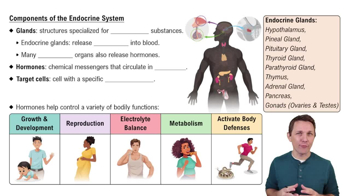
Endocrine glands secrete hormones into the bloodstream to maintain homeostasis through negative feedback loops.
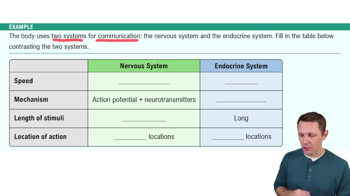
Hormones are secreted into interstitial spaces and bloodstream, then bind to receptors on target cells located far from the secretory cell.
Endocrine secretion releases hormones into the bloodstream; exocrine secretion releases substances through ducts to body surfaces.
Direct (gap junctions), paracrine (local factors), endocrine (hormones via blood), and synaptic (neurotransmitters across synapses).
Hypothalamus, pituitary, pineal, thyroid, parathyroid, adrenal glands, pancreas, plus heart, digestive tract, kidneys, and gonads with secondary endocrine functions.
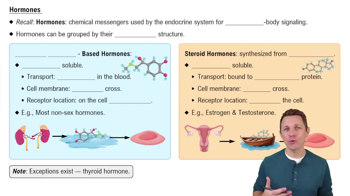
Amino acid derivatives, peptide hormones, and lipid derivatives.
Thyroid hormones (thyroxine), catecholamines (epinephrine, norepinephrine, dopamine), and melatonin.
Short polypeptides like antidiuretic hormone, oxytocin, insulin, growth hormone, and glycoproteins like thyroid stimulating hormone.
Eicosanoids (leukotrienes, prostaglandins) and steroid hormones (estrogen, testosterone, corticosteroids, calcitriol) derived from cholesterol.
Cells must have specific protein receptors; different receptors on different cells cause varied effects from the same hormone.
Catecholamines bind membrane receptors activating G-proteins, producing cAMP or releasing Ca2+, which act as secondary messengers to open ion channels or activate enzymes.
Steroid hormones diffuse through membranes, bind receptors in cytoplasm or nucleus, then the complex binds DNA to regulate gene transcription.
Carried across membranes by proteins, thyroid hormones bind receptors on mitochondria to increase ATP or in nucleus to increase gene transcription.
The process outcome inhibits its own production, e.g., hormone action signals hypothalamus to reduce hormone release.
Antidiuretic hormone (ADH) and oxytocin.
It secretes releasing and inhibiting hormones transported via the hypophyseal portal system to control anterior pituitary hormone secretion.
Growth hormone, prolactin, thyroid-stimulating hormone, adrenocorticotropic hormone, follicle-stimulating hormone, and luteinizing hormone.
ADH promotes water retention in kidneys and regulates blood pressure; oxytocin stimulates childbirth and milk ejection.
Located anterior to the trachea, it has two lobes connected by an isthmus and contains thyroid follicles lined by cuboidal epithelium.
Triiodothyronine (T3) contains 3 iodine atoms; thyroxine (T4) contains 4 iodine atoms, both derived from thyroglobulin.
Iodide is absorbed, oxidized by thyroid peroxidase, attached to tyrosine in thyroglobulin, then processed to release T3 and T4 into the bloodstream.
Produced by C cells in the thyroid, it lowers blood calcium by increasing bone uptake and reducing bone resorption.
PTH increases blood calcium by stimulating bone release, kidney reabsorption, and calcitriol production to enhance intestinal absorption.
Medulla produces catecholamines (epinephrine, norepinephrine); cortex produces steroid hormones like aldosterone, cortisol, and androgens.
Aldosterone promotes sodium retention in kidneys, leading to water retention and increased blood volume.
Cortisol is a glucocorticoid that inhibits protein synthesis and stimulates glucose production in the liver.
Beta cells produce insulin to lower blood glucose; alpha cells produce glucagon to raise blood glucose.
A disorder of high blood glucose: Type 1 is insulin deficiency (autoimmune), Type 2 is insulin resistance (common in adults).
Energy crisis in cells, increased blood pressure, damage to heart, kidneys, eyes, nerves, and extremities.
Produces melatonin, which regulates circadian rhythms based on light and dark cycles.
Supports maturation of T cells in the immune system and shrinks with age.