 Back
Anatomy & Physiology Exam 1 Review
 04:01

Terms in this set (20)
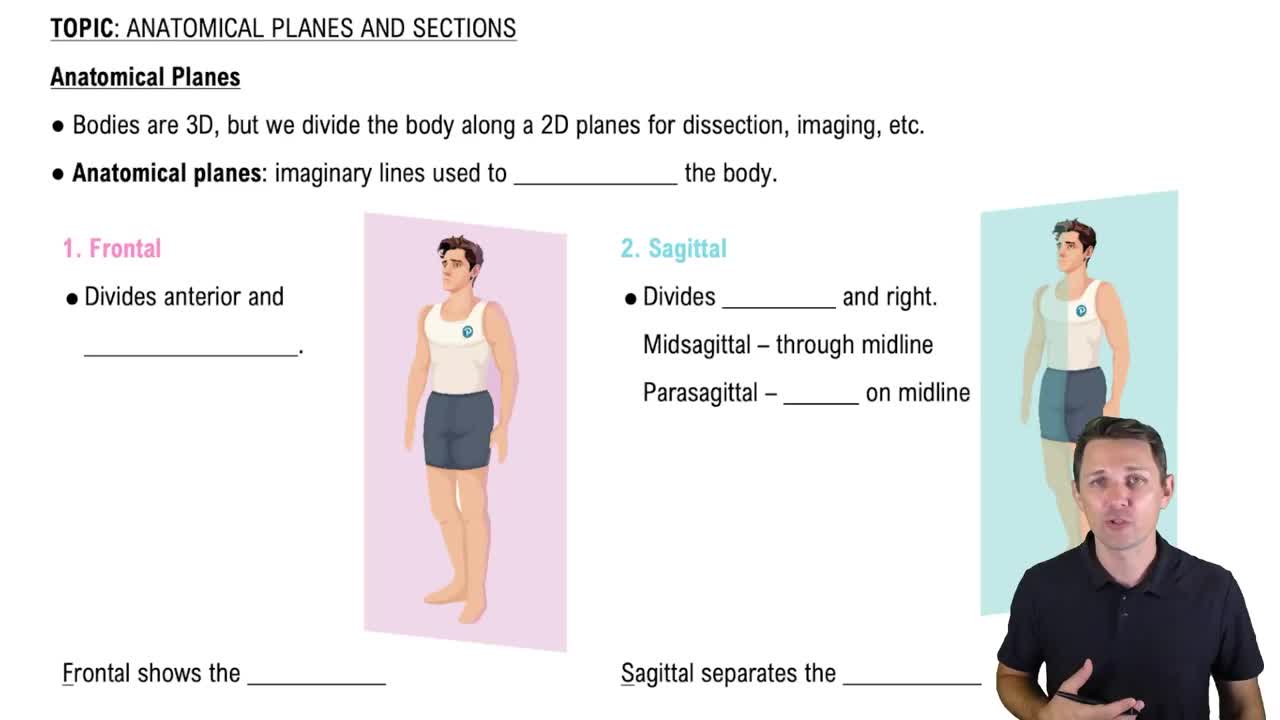
The body is standing upright, facing forward, feet flat and slightly apart, arms at the sides with palms facing forward.
The central part of the body including the head, neck, and trunk.
The limbs or appendages attached to the axial region.
Above or higher in position relative to another part.
Below or lower in position relative to another part.
It controls the movement of substances in and out of the cell and provides protection.
They produce energy (ATP) through cellular respiration.
Epithelial, connective, muscle, and nervous tissue.
Stratum corneum, stratum lucidum (only in thick skin), stratum granulosum, stratum spinosum, stratum basale.
The passive movement of molecules from an area of higher concentration to an area of lower concentration.
The diffusion of water across a selectively permeable membrane.
A structure made of microtubules that segregates chromosomes during mitosis.
The imaginary plane where chromosomes line up during metaphase.
The property of the plasma membrane that allows some substances to pass while blocking others.
They synthesize proteins by translating mRNA.
Endocrine glands secrete hormones into the bloodstream; exocrine glands secrete substances through ducts to an epithelial surface.
It provides pigmentation to the skin and protects against UV radiation.
Proximal means closer to the point of attachment; distal means farther from the point of attachment.
It modifies, sorts, and packages proteins and lipids for transport.
Parietal (lines body cavities) and visceral (covers organs).