What forms a spinal nerve and what type of nerve is it?
A spinal nerve is formed by the union of a sensory posterior (dorsal) root and a motor anterior (ventral) root; the resulting spinal nerve is a mixed nerve containing both sensory and motor fibers.
What is a dermatome?
A dermatome is an area of skin supplied primarily by one spinal nerve level; dermatomes overlap but are distinct from peripheral nerve territories.
How does the varicella-zoster virus cause shingles?
After chickenpox, varicella-zoster virus remains latent in sensory ganglia and can reactivate as shingles, producing painful, typically unilateral dermatomal vesicles.
Define neuronal pool and name four major patterns of neuronal interaction.
A neuronal pool is an interconnected group of interneurons with limited inputs and outputs. Patterns include divergence, convergence, serial processing, and parallel processing.
What is divergence in neuronal pools?
Divergence occurs when one neuron sends information to many neurons or pools, amplifying or distributing signals.
What is convergence in neuronal pools?
Convergence is when multiple neurons synapse on one neuron, integrating signals from multiple sources.
Describe serial and parallel processing in neuronal pools.
Serial processing moves signals step-by-step along one pathway producing a specific response; parallel processing involves several pathways processing the same input simultaneously for coordinated responses.
What are the five elements of a reflex arc?
The five elements are: receptor, sensory neuron, CNS integration center, motor neuron, and effector.
How are reflexes classified?
Reflexes are classified by development (innate vs acquired), effect (somatic vs visceral), circuit complexity (monosynaptic vs polysynaptic), and processing center (spinal vs cranial).
What distinguishes monosynaptic from polysynaptic reflexes?
Monosynaptic reflexes have exactly one synapse between sensory and motor neurons; polysynaptic reflexes involve at least one interneuron and two or more synapses.
Describe the stretch reflex mechanism.
The muscle spindle senses increased muscle length; the sensory neuron directly excites the alpha motor neuron causing the stretched muscle to contract, maintaining muscle length and tone.
What is the role of Golgi tendon organs in reflexes?
Golgi tendon organs detect excessive tension at the muscle-tendon junction and activate inhibitory interneurons to reduce muscle contraction, preventing injury; this is the tendon reflex.
Explain the withdrawal and crossed extensor reflexes.
Withdrawal reflex excites flexors and inhibits extensors on the same side to remove a limb from a painful stimulus. Crossed extensor reflex extends the opposite limb to support body weight.
What are the features of polysynaptic reflexes?
Polysynaptic reflexes involve interneuron pools, can excite or inhibit targets, may span multiple spinal segments, activate muscles in multiple regions, and use reciprocal inhibition for coordinated muscle action.
How do higher brain centers influence spinal reflexes?
Higher centers can facilitate or inhibit spinal reflexes via descending motor pathways, modifying reflex intensity without initiating the reflex.
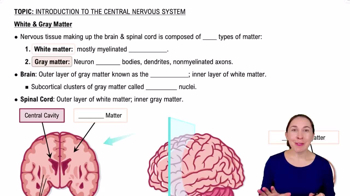
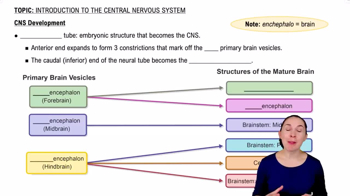
Name the four general brain regions and their primary functions.
List the three meninges surrounding the brain from outermost to innermost.
Dura mater (outer), arachnoid mater (middle), and pia mater (innermost, adheres to brain surface).
Where does cerebrospinal fluid (CSF) circulate and what is its function?
CSF circulates in the ventricles and subarachnoid space, providing cushioning, buoyancy, nutrient transport, and waste removal for the CNS.
What is the blood-brain barrier (BBB) and its main components?
The BBB restricts uncontrolled blood-to-brain transfer; tight junctions between capillary endothelial cells form the physical barrier, with astrocyte end-feet regulating permeability.
What are the main functions of the medulla oblongata?
The medulla controls cardiovascular and respiratory centers, relays sensory information, contains pyramidal tracts for motor control, and houses nuclei for several cranial nerves.
Describe the corticospinal pathway and its role.
The corticospinal pathway carries voluntary, skilled motor commands from the cerebral motor cortex to spinal motor neurons, with most fibers crossing at the medullary pyramids.
What is the difference between the lateral and anterior corticospinal tracts?
Lateral corticospinal fibers cross at the medullary pyramids and control fine limb movements; anterior corticospinal fibers descend ipsilaterally and may cross near their spinal targets, mainly controlling axial muscles.
What is the function of the basal nuclei in motor control?
Basal nuclei facilitate desired motor programs and inhibit unwanted movements by modulating thalamocortical and brainstem circuits.
What role does the cerebellum play in movement?
The cerebellum compares intended movement with sensory feedback to coordinate timing, accuracy, posture, balance, and motor learning.
What is the sensory homunculus?
A cortical map on the postcentral gyrus representing body regions proportionally to sensory receptor density, not physical size.
What is the motor homunculus?
A cortical map on the precentral gyrus representing body regions proportionally to the precision of motor control.
Define referred pain and its clinical significance.
Referred pain is perceived at a somatic site distant from the actual visceral source due to convergence of visceral and somatic inputs in the CNS; it aids diagnosis but is not definitive alone.
What are the three major somatic sensory pathways and their sensations?
Spinothalamic tract: pain, temperature, crude touch; Posterior column: fine touch, vibration, conscious proprioception; Spinocerebellar tract: unconscious proprioception for coordination.
How do tonic and phasic receptors differ?
Tonic receptors adapt slowly and maintain sustained responses; phasic receptors adapt rapidly and respond mainly to changes in stimulus.
 Back
 0:50