Skip to main content
Anatomy & Physiology
My Course
Learn
Exam Prep
AI Tutor
Study Guides
Textbook Solutions
Flashcards
Explore
Try the app
My Course
Learn
Exam Prep
AI Tutor
Study Guides
Textbook Solutions
Flashcards
Explore
Try the app
Back
Anatomy & Physiology Exam 3 Study Review
You can tap to flip the card.
Alimentary canal vs accessory organs
You can tap to flip the card.
👆
Alimentary canal vs accessory organs
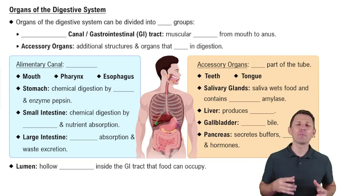
Alimentary canal
is the tube food passes through (mouth to anus).
Accessory organs
assist digestion (teeth, tongue, salivary glands, liver, gallbladder, pancreas).
Track progress
Control buttons has been changed to "navigation" mode.
1/28
Recommended videos
Guided course
4:06
Introduction to the Digestive System Example 2
5166
views
96
rank
Guided course
5:08
Functions of the Digestive System
6323
views
134
rank
Guided course
6:28
Organs of the Digestive System
9606
views
282
rank
1
comments
Terms in this set (28)
Hide definitions
Alimentary canal vs accessory organs
Alimentary canal
is the tube food passes through (mouth to anus).
Accessory organs
assist digestion (teeth, tongue, salivary glands, liver, gallbladder, pancreas).
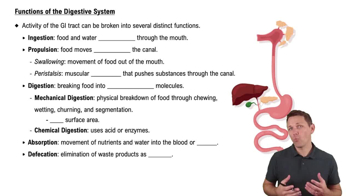
6 processes of digestion
Ingestion, propulsion, mechanical breakdown, digestion (enzymes), absorption, defecation.
Layers of the GI tract
Mucosa
(secretion/absorption),
Submucosa
(blood vessels and nerves),
Muscularis externa
(movement),
Serosa/adventitia
(outer covering).
Enteric nervous system (ENS) functions
Myenteric plexus
controls motility;
Submucosal plexus
controls secretion.
Salivary glands and their secretions
Parotid
: watery with enzymes;
Submandibular
: mixed;
Sublingual
: mucus. Saliva contains salivary amylase (breaks carbs) and lysozyme (kills bacteria).
Phases of swallowing (deglutition)
Voluntary phase (tongue pushes food), pharyngeal phase (epiglottis closes airway), esophageal phase (peristalsis moves food).
Gastric gland cell types and secretions
Mucous cells
: mucus;
Parietal cells
: HCl and intrinsic factor;
Chief cells
: pepsinogen;
Enteroendocrine cells
: hormones like gastrin.
3 phases of gastric secretion regulation
Cephalic phase (sight/smell increases acid), gastric phase (food in stomach increases acid), intestinal phase (slows stomach activity).
Functions of liver, gallbladder, and pancreas
Liver produces bile; gallbladder stores bile; pancreas produces digestive enzymes.
Hormones regulating digestion
Cholecystokinin (CCK)
releases bile and pancreatic enzymes;
Secretin
releases bicarbonate.
Small intestine adaptations for absorption
Villi and microvilli increase surface area for nutrient absorption.
Differences between small and large intestine
Small intestine has villi for absorption; large intestine has no villi, many goblet cells, and absorbs water.
Gut flora roles
Produce vitamin K, aid digestion, and protect from pathogens.
Defecation control
Parasympathetic nervous system controls defecation; internal anal sphincter is involuntary; external anal sphincter is voluntary.
Digestion products and absorption routes
Carbohydrates and proteins absorbed into blood; fats absorbed into lymph as chylomicrons.
Kidney main functions
Filter blood, balance fluids and pH, regulate blood pressure.
Renal corpuscle components
Glomerulus and Bowman’s capsule; filters blood to form filtrate.
Nephron tubule segments
Proximal convoluted tubule (PCT), nephron loop (Loop of Henle), distal convoluted tubule (DCT), collecting duct.
Glomerular filtration rate (GFR) formula
Net filtration pressure (NFP) = GHP - (GCOP + CHP), where GHP = glomerular hydrostatic pressure, GCOP = glomerular colloid osmotic pressure, CHP = capsular hydrostatic pressure.
Hormones affecting kidney function
ADH
increases water reabsorption;
Aldosterone
increases sodium reabsorption;
ANP
increases urine output.
Renin-Angiotensin-Aldosterone System (RAAS) triggers and effects
Triggered by low blood pressure and low GFR; causes vasoconstriction, increased sodium and water retention, raising blood pressure.
Normal vs abnormal urine components
Normal: water, urea, creatinine, H+, HCO3-, Na+, K+. Abnormal: glucose, amino acids, proteins, leukocytes, erythrocytes.
Male reproductive hormone effects
Testosterone promotes male traits and sperm production; high testosterone causes negative feedback reducing LH and FSH.
Female ovarian cycle phases
Follicular phase (follicle growth), ovulation (day 14, LH surge), luteal phase (progesterone production).
Menstrual cycle phases
Menstrual phase, proliferative phase, secretory phase.
Sperm path through male reproductive system
Testes → epididymis → vas deferens → urethra.
Cell secretions in digestion
Parietal cells: HCl + intrinsic factor; Chief cells: pepsinogen; Hepatocytes: bile; Goblet cells: alkaline mucus; Acinar cells: pancreatic enzymes.
Defecation vs micturition sphincter control
Both use internal sphincter (involuntary, parasympathetic) and external sphincter (voluntary, brain control).
 BackBack
 4:06
4:06