Back

Anatomy & Physiology Exam 4 Study Guide Flashcards

Control buttons has been changed to "navigation" mode.
1/30
  • Functions of the urinary system in blood homeostasis

    Maintains blood pH, water balance, electrolyte concentrations, nutrient conservation, and waste excretion including urea, creatinine, and uric acid.
  • Filtration barriers in the renal corpuscle

    Consist of fenestrated endothelium, basement membrane, and podocyte filtration slits; afferent arteriole diameter is larger than efferent to increase pressure and facilitate filtration.
  • Net filtration pressure (NFP) calculation

    NFP = (glomerular hydrostatic pressure) - (capsular hydrostatic pressure + blood colloid osmotic pressure).
  • Control mechanisms of glomerular filtration

    Include autoregulation, hormonal regulation (renin-angiotensin-aldosterone system and natriuretic peptides), and autonomic regulation.
  • Types of membrane transport in kidney function

    Diffusion, osmosis, carrier-mediated transport, and active transport move substances across nephron membranes for filtration, reabsorption, and secretion.
  • Renal threshold and transport maximum

    Renal threshold is the plasma concentration at which a substance begins to appear in urine; transport maximum is the maximum rate carriers can reabsorb a substance.
  • Specialized functions of nephron regions

    Proximal tubule reabsorbs most solutes; loop of Henle creates concentration gradient; distal tubule and collecting duct adjust water and solute reabsorption hormonally.
  • Counter-current multiplication and exchange

    Mechanism in the loop of Henle and vasa recta that concentrates urine by creating and maintaining an osmotic gradient in the medulla.
  • Differences between filtration, secretion, and reabsorption

    Filtration is movement from blood to nephron; secretion is active transport into nephron; reabsorption is movement from nephron back to blood.
  • Hormonal control of water reabsorption in distal tubule and collecting duct

    Antidiuretic hormone (ADH) increases water permeability; aldosterone increases sodium reabsorption, indirectly affecting water retention.
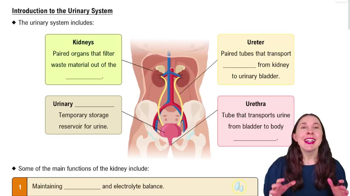
  • Urine pathway from collecting ducts to excretion

    Collecting ducts → papillary ducts → minor calyces → major calyces → renal pelvis → ureters → urinary bladder → urethra → outside body.
  • Histology of excretory organs related to function

    Transitional epithelium allows stretching; smooth muscle layers enable peristalsis for urine transport.
  • Micturition reflex control mechanisms

    Involuntary spinal reflex triggers bladder contraction; voluntary control via external urethral sphincter allows conscious urination.
  • Major age-related changes affecting urinary excretion

    Reduced nephron number, decreased glomerular filtration rate, and impaired bladder control.
  • Major functions of the digestive tract

    Ingestion, propulsion, mechanical digestion, chemical digestion, absorption, and defecation.
  • Neural and hormonal control of digestive activity

    Includes local reflexes, autonomic nervous system, and hormones like gastrin, secretin, and cholecystokinin regulating motility and secretion.
  • Functions of saliva

    Moistens food, begins starch digestion with amylase, lubricates oral cavity, and contains antimicrobial agents.
  • Control of salivation

    Primarily controlled by parasympathetic nervous system; stimulated by food smell, taste, and chewing.
  • Secretory cells of the stomach and their products

    Parietal cells secrete HCl and intrinsic factor; chief cells secrete pepsinogen; mucous cells secrete mucus.
  • Formation and function of HCl in the stomach

    Parietal cells secrete H+ and Cl- separately; HCl activates pepsinogen to pepsin and kills microbes.
  • Protection of stomach lining from acid

    Mucus layer and bicarbonate secretion protect epithelium; rapid cell turnover repairs damage.
  • Phases of gastric secretion regulation

    Cephalic phase (brain stimulation), gastric phase (stomach distension and peptides), intestinal phase (duodenal feedback).
  • Major exocrine secretions of the pancreas

    Digestive enzymes (amylase, lipase, proteases) and bicarbonate-rich fluid to neutralize stomach acid.
  • Liver microanatomy and function

    Portal triads deliver blood; hepatocytes perform metabolism; Kupffer cells remove debris; sinusoids facilitate exchange.
  • Bile synthesis, storage, and recycling

    Hepatocytes synthesize bile; stored in gallbladder; bile salts aid fat digestion; recycled via enterohepatic circulation.
  • Functions of duodenal hormones

    Gastrin stimulates acid; secretin stimulates bicarbonate; CCK stimulates enzyme secretion; GIP inhibits gastric motility; VIP relaxes smooth muscle.
  • Specialized functions of the large intestine

    Absorbs water and electrolytes; forms and stores feces; houses microbiota for fermentation.
  • Differences between small and large intestine

    Small intestine specializes in nutrient absorption; large intestine absorbs water and compacts feces.
  • Digestion and absorption of carbohydrates, lipids, and proteins

    Carbohydrates broken down by amylase; lipids by lipase; proteins by proteases; absorbed mainly in small intestine.
  • Major ions absorbed in the digestive tract

    Sodium, potassium, calcium, magnesium, phosphate, and chloride are absorbed primarily in the small intestine.