Back

Anatomy & Physiology Final Exam High-Yield Review

Control buttons has been changed to "navigation" mode.
1/37
  • Sympathetic vs Parasympathetic nervous system

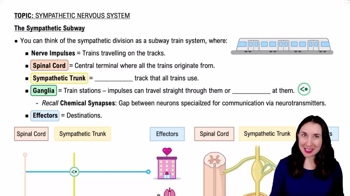
    Sympathetic is fight or flight; Parasympathetic is rest and digest.
  • Myopia vs Hyperopia

    Myopia is nearsightedness; Hyperopia is farsightedness.
  • Osteoblast vs Osteoclast

    Osteoblasts build bone; Osteoclasts break down bone.
  • Afferent vs Efferent neurons

    Afferent neurons carry sensory signals to CNS; Efferent neurons carry motor signals away from CNS.
  • Endocrine vs Exocrine glands

    Endocrine glands secrete hormones into blood; Exocrine glands secrete into ducts.
  • Rods vs Cones in the eye

    Rods detect night vision; Cones detect color vision.
  • Compact bone vs Spongy bone

    Compact bone has dense osteons; Spongy bone has trabeculae.
  • Isotonic vs Isometric muscle contraction

    Isotonic involves movement; Isometric involves no movement.
  • Mnemonic SAME

    SAME = Sensory Afferent, Motor Efferent.
  • Mnemonic SLUDD

    SLUDD = Salivation, Lacrimation, Urination, Digestion, Defecation.
  • Cranial nerve that innervates heart and digestive organs

    Vagus nerve (CN X).
  • Hormone that lowers blood glucose

    Insulin.
  • Cells that break down bone

    Osteoclasts.
  • Cause of depolarization in neurons

    Na+ influx.
  • Resting membrane potential value

    -70 mV.
  • Eye receptors that detect color

    Cones.
  • Joint with greatest range of motion

    Ball-and-socket joint.
  • Hormone that increases blood calcium

    Parathyroid hormone (PTH).
  • Where cerebrospinal fluid (CSF) is produced

    Choroid plexus.
  • Division of autonomic nervous system that is thoracolumbar

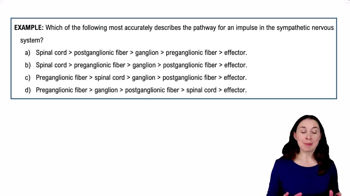
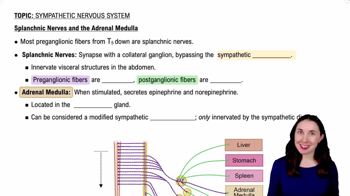
    Sympathetic nervous system.
  • Sliding filament theory summary

    During contraction, actin slides past myosin. Calcium binds troponin exposing actin sites. Myosin pulls actin using ATP. Sarcomeres shorten.
  • Renin-angiotensin-aldosterone system (RAAS) pathway

    Low BP → kidneys release renin → angiotensinogen to angiotensin I → ACE converts to angiotensin II → vasoconstriction + aldosterone release → sodium and water retention → increased BP.
  • Comparison of sympathetic and parasympathetic effects

    Sympathetic increases heart rate, dilates pupils, inhibits digestion. Parasympathetic conserves energy, promotes digestion, urination, lowers heart rate.
  • Visual pathway

    Cornea → pupil → lens → retina → optic nerve → optic chiasm → visual cortex.
  • Auditory pathway

    Tympanic membrane → ossicles → oval window → cochlea → CN VIII → auditory cortex.
  • Muscle contraction pathway

    ACh release → depolarization → Ca++ release → contraction.
  • RAAS pathway steps

    Renin → angiotensin I → ACE → angiotensin II → aldosterone.
  • Function of CN VIII

    Hearing and balance.
  • Role of hypothalamus

    Controls the pituitary gland.
  • Role of thalamus

    Acts as a sensory relay station.
  • Role of cerebellum

    Coordinates movement.
  • Role of medulla

    Controls vital autonomic functions.
  • Neurotransmitter ACh in ANS

    Acetylcholine (ACh) is excitatory.
  • Neurotransmitter released by sympathetic postganglionic neurons

    Norepinephrine.
  • Fovea centralis function

    Has highest cone density for sharp vision.
  • Type of secretion by sebaceous glands

    Holocrine secretion.
  • Type of secretion by sweat glands

    Merocrine secretion.