Back

Anatomy & Physiology Final Exam Review

Control buttons has been changed to "navigation" mode.
1/25
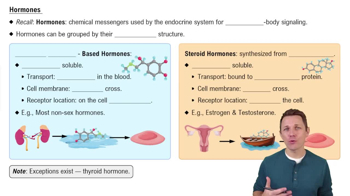
  • Difference between amino acid-based and steroid hormones' modes of action

    Amino acid-based hormones act via cell membrane receptors and second messengers; steroid hormones pass through the membrane and act on intracellular receptors.
  • Factors affecting target cell activation by hormones

    Target cell activation depends on hormone blood levels, receptor number, and receptor affinity.
  • Hypothalamus role in anterior pituitary regulation

    The hypothalamus secretes releasing and inhibiting hormones that regulate anterior pituitary hormone secretion.
  • Hormones released by the posterior pituitary

    The posterior pituitary releases oxytocin and antidiuretic hormone (ADH), produced by the hypothalamus.
  • Structure and function of the thyroid gland

    The thyroid gland produces thyroid hormones (T3, T4) regulating metabolism and calcitonin for calcium homeostasis.
  • Disorders from hypo- or hypersecretion of thyroid hormones

    Hyposecretion causes hypothyroidism (e.g., goiter, cretinism); hypersecretion causes hyperthyroidism (e.g., Graves' disease).
  • Main components of blood

    Blood consists of plasma (water, proteins, nutrients) and formed elements (erythrocytes, leukocytes, platelets).
  • Hormone regulating red blood cell production

    Erythropoietin (EPO) stimulates RBC production; released mainly by the kidneys in response to low oxygen.
  • Three steps of hemostasis

    Hemostasis involves vascular spasm, platelet plug formation, and coagulation (blood clotting).
  • Pathway of blood flow through the heart

    Blood flows: vena cava → right atrium → right ventricle → pulmonary artery → lungs → pulmonary veins → left atrium → left ventricle → aorta.
  • Structures of the intrinsic cardiac conduction system

    SA node → AV node → AV bundle → bundle branches → Purkinje fibers coordinate heartbeats.
  • Definition of cardiac output

    Cardiac output is the volume of blood pumped by the heart per minute; CO = heart rate × stroke volume.
  • Generalized pathway of blood vessels

    Blood flows from arteries → arterioles → capillaries → venules → veins.
  • Mean arterial pressure (MAP)

    MAP is the average arterial pressure during a cardiac cycle; it drives blood flow through tissues.
  • Four processes of respiration

    Pulmonary ventilation, external respiration, transport of gases, and internal respiration.
  • Role of surfactant in alveoli

    Surfactant reduces surface tension in alveoli, preventing collapse during exhalation.
  • Muscles involved in inspiration

    The diaphragm and external intercostal muscles contract to increase thoracic volume during inspiration.
  • Six essential activities of digestion

    Ingestion, propulsion, mechanical digestion, chemical digestion, absorption, and defecation.
  • Functional unit of the kidney

    The nephron filters blood and forms urine through filtration, reabsorption, and secretion.
  • Hormones affecting kidney function and blood pressure

    Renin, angiotensin II, aldosterone, ADH, and ANP regulate kidney ion reabsorption and blood pressure.
  • Fluid compartments and primary electrolytes

    Intracellular fluid (high K+), extracellular fluid (high Na+), including plasma and interstitial fluid.
  • Difference between respiratory and metabolic acidosis/alkalosis

    Respiratory involves CO2 changes; metabolic involves bicarbonate or acid changes; body compensates via respiratory or renal adjustments.
  • Organs producing gametes and hormones

    Testes produce sperm and testosterone; ovaries produce eggs, estrogen, and progesterone.
  • Difference between spermatogenesis and oogenesis

    Spermatogenesis produces four sperm continuously; oogenesis produces one ovum and polar bodies cyclically.
  • Phases of the ovarian cycle

    Follicular phase, ovulation, and luteal phase regulate egg maturation and hormone secretion.