 Back
Anatomy & Physiology Flashcards
 02:59

Terms in this set (20)
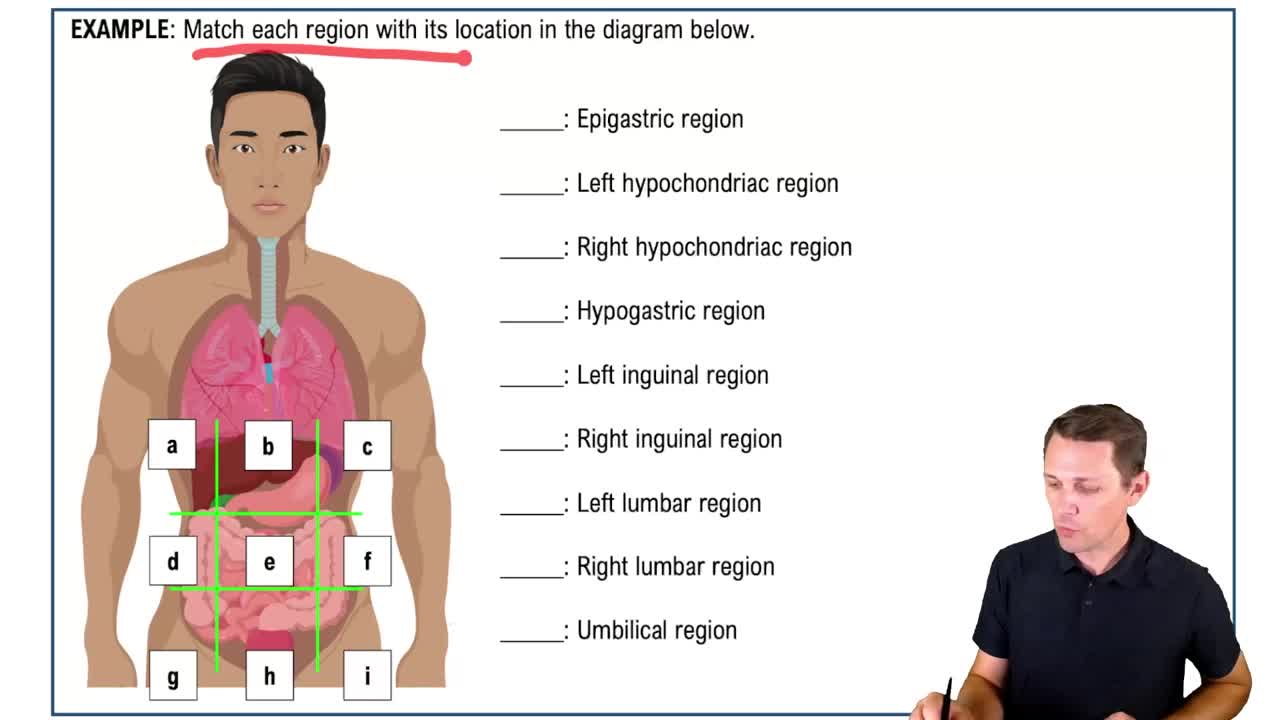
The nine regions are Right hypochondriac, Epigastric, Left hypochondriac, Right lumbar, Umbilical, Left lumbar, Right iliac, Hypogastric, and Left iliac regions.
Chromosomes condense and become visible, spindle fibers form, and the nuclear envelope begins to break down.
Chromosomes align at the cell's equatorial plate, attached to spindle fibers from opposite poles.
Sister chromatids separate and move toward opposite poles of the cell.
Chromosomes decondense, nuclear envelopes reform around each set, and the cell prepares to divide.
Epithelial tissue covers body surfaces, lines cavities, and forms glands for protection, absorption, and secretion.
Bone tissue has a matrix of collagen fibers and mineral salts, organized into osteons with central canals.
Smooth muscle cells are spindle-shaped, non-striated, and have a single central nucleus.
Red blood cells transport oxygen from the lungs to body tissues and carry carbon dioxide back to the lungs.
Pseudostratified ciliated columnar epithelium with goblet cells.
Connective tissue supports, binds, and protects organs and tissues throughout the body.
The skin consists of the epidermis, dermis, and hypodermis (subcutaneous layer).
The skull is formed by the frontal, parietal, temporal, occipital, sphenoid, and ethmoid bones, among others.
The mandible is the lower jawbone, the largest and strongest bone of the face.
The atlas is the first cervical vertebra that supports the skull and allows nodding motion.
The vertebral body supports weight and forms the anterior portion of a vertebra.
Ribs are curved bones forming the thoracic cage; the first 7 are true ribs, ribs 8-12 are false ribs.
The scapula is the shoulder blade, a flat triangular bone connecting the humerus with the clavicle.
The pelvis is formed by the ilium, ischium, and pubis bones.
The foot skeleton includes the tarsals, metatarsals, and phalanges.