Skip to main content
Anatomy & Physiology
My Course
Learn
Exam Prep
AI Tutor
Study Guides
Textbook Solutions
Flashcards
Explore
Try the app
My Course
Learn
Exam Prep
AI Tutor
Study Guides
Textbook Solutions
Flashcards
Explore
Try the app
Back
Anatomy & Physiology Histology and Endocrine System Flashcards
You can tap to flip the card.
Layers of artery and vein walls
You can tap to flip the card.
👆
Layers of artery and vein walls
Adventitia
,
media
, and
intima
are the main layers; arteries have thicker media than veins.
Track progress
Control buttons has been changed to "navigation" mode.
1/24
Recommended videos
7:06
Components of the Endocrine System
14827
views
454
rank
6:20
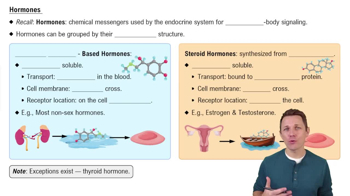
Hormones
11300
views
282
rank
3:33
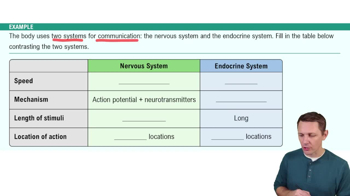
Introduction to the Endocrine System Example 1
16057
views
487
rank
1
comments
Terms in this set (24)
Hide definitions
Layers of artery and vein walls
Adventitia
,
media
, and
intima
are the main layers; arteries have thicker media than veins.
Function of artery lumen
The
artery lumen
is the central blood-carrying space surrounded by thick muscular walls.
Function of vein lumen
The
vein lumen
is larger and less muscular, allowing blood to return to the heart under lower pressure.
Histology of respiratory alveoli
Alveoli are thin-walled sacs surrounded by capillaries for gas exchange.
Structure of thyroid gland
Contains follicles lined by epithelial cells producing thyroxine and stores colloid.
Parathyroid gland function
Produces parathyroid hormone to regulate blood calcium levels.
Adrenal gland zones
Includes zona glomerulosa, zona fasciculata, zona reticularis, and medulla producing different hormones.
Pancreatic islets (Islets of Langerhans)
Clusters of endocrine cells producing insulin (β cells) and glucagon (α cells).
Types of pancreatic cells
α cells produce glucagon, β cells produce insulin, and acinar cells produce digestive enzymes.
Anterior pituitary cell types
Includes acidophils, basophils, and chromophobes producing various hormones.
Neutrophil identification
A type of white blood cell with multi-lobed nucleus involved in phagocytosis.
Monocyte function
A large white blood cell that differentiates into macrophages for immune defense.
Erythrocyte characteristics
Red blood cells that carry oxygen via hemoglobin, lack nucleus.
Platelet role
Cell fragments involved in blood clotting.
Blood type testing
Determines presence of A, B antigens and Rh factor to classify blood groups.
Effect of thyroxine on BMR
Thyroxine increases basal metabolic rate by stimulating cellular metabolism.
Role of TSH
Thyroid-stimulating hormone regulates thyroid gland activity and hormone release.
Effect of propylthiouracil
Inhibits thyroid hormone synthesis, lowering BMR.
Estrogen effect on bone density
Estrogen helps maintain bone density by inhibiting bone resorption.
Insulin effect on blood sugar
Lowers blood glucose by promoting cellular uptake and storage.
Vagus nerve effect on heart rate
Decreases heart rate via parasympathetic stimulation.
Epinephrine effect on heart rate
Increases heart rate and contractility via sympathetic stimulation.
Surfactant function in lungs
Reduces surface tension in alveoli, increasing tidal volume.
Asthma inhaler effect
Dilates bronchioles to improve airflow.
 BackBack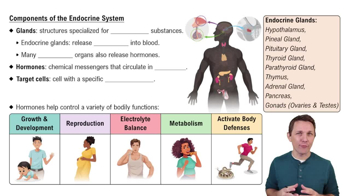
 7:06
7:06