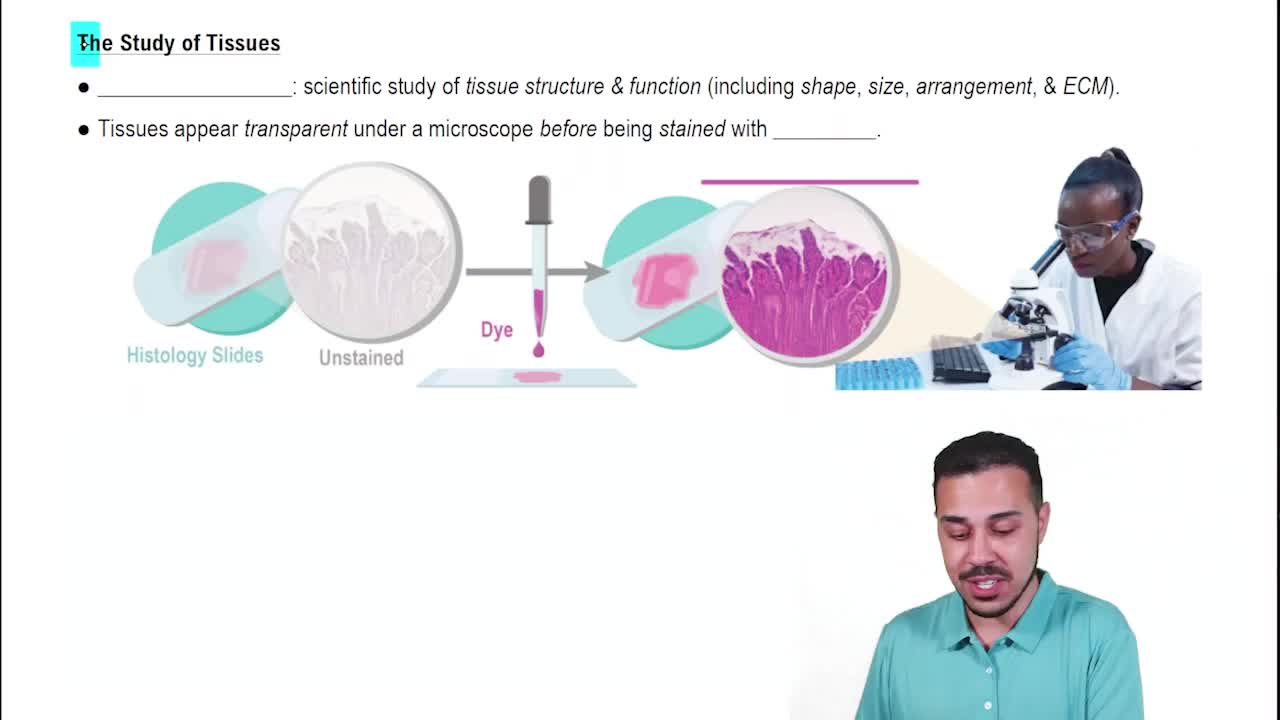
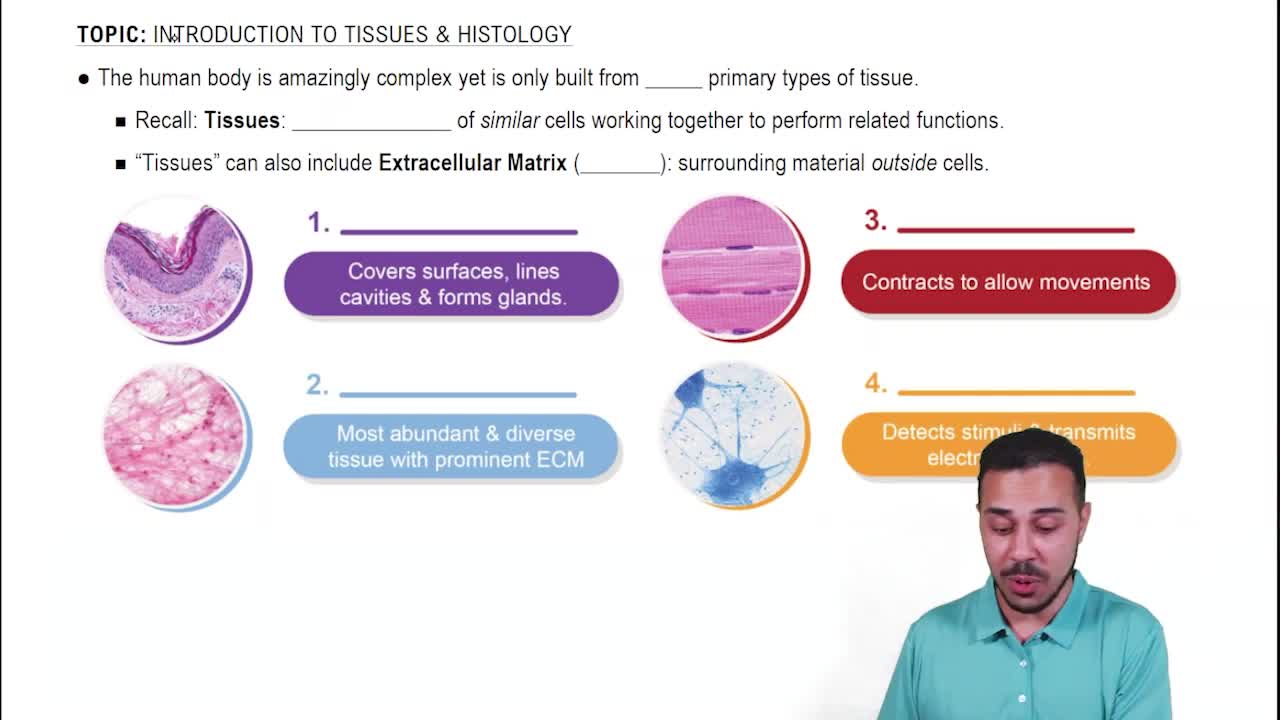
What are the four primary tissue types in the human body?
Epithelial, connective, muscle, and nervous tissues.
How are epithelial tissues classified by cell shape?
Squamous (scale-like), cuboidal (cube-like), and columnar (column-like).
What are the classifications of epithelial tissue by cell layers?
Simple (one layer), stratified (multiple layers), pseudostratified (one layer but appears layered), and transitional (can change shape).
What is the main function of simple squamous epithelium?
Allows materials to pass by diffusion and filtration where protection is not important; secretes lubricating substances in serosae.
Where is simple squamous epithelium typically found?
Kidney glomeruli, air sacs of lungs, lining of heart, blood vessels, and lymphatic vessels.
Describe simple cuboidal epithelium and its function.
Single layer of cube-like cells with large spherical nuclei; functions in secretion and absorption.
Where is simple cuboidal epithelium located?
Kidney tubules, ducts and secretory portions of small glands, and ovary surface.
What characterizes simple columnar epithelium?
Single layer of tall cells with round to oval nuclei; may have cilia and goblet cells.
What are the functions of simple columnar epithelium?
Absorption, secretion of mucus, enzymes, and other substances; ciliated type propels mucus by ciliary action.
Where is pseudostratified columnar epithelium found and what is its function?
Lines male sperm-carrying ducts and trachea; secretes substances, particularly mucus, and propels mucus by ciliary action.
What is the structure and function of stratified squamous epithelium?
Thick membrane with several cell layers; protects underlying tissues in areas subject to abrasion.
What is the difference between keratinized and non-keratinized stratified squamous epithelium?
Keratinized has a surface layer of dead cells filled with keratin for protection and dehydration prevention; non-keratinized remains moist.
Where is stratified cuboidal epithelium found and what is its function?
Found in largest ducts of sweat glands, mammary glands, and salivary glands; functions in protection.
Describe stratified columnar epithelium and its location.
Several cell layers with basal cells cuboidal and surface cells elongated; rare, found in male urethra and some gland ducts.
What is transitional epithelium and its function?
Resembles both stratified squamous and cuboidal; surface cells dome-shaped or squamous-like; stretches to permit stored urine to distend urinary organ.
Where is transitional epithelium located?
Lines ureters, bladder, and part of the urethra.
What are the major functions of epithelial tissue?
Protection, absorption, filtration, excretion, secretion, and sensory reception.
What is the apical surface of epithelial tissue?
The free surface exposed to the body exterior or the cavity of an internal organ.
What is the basal surface of epithelial tissue?
The surface attached to underlying connective tissue via the basement membrane.
What is keratin and its role in epithelial tissue?
A family of fibrous structural proteins forming intermediate filaments; keratinized epithelium protects from abrasion and dehydration.
 Back
Back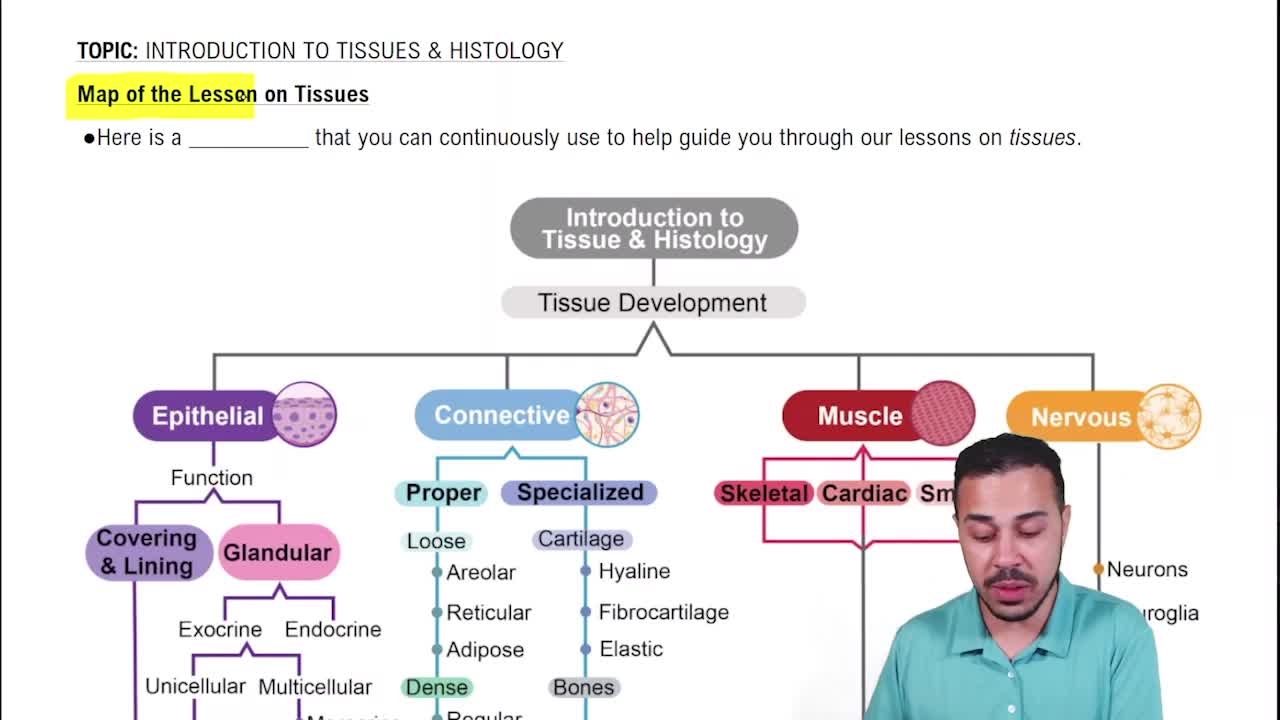
 03:32
03:32