Skip to main content
Anatomy & Physiology
My Course
Learn
Exam Prep
AI Tutor
Study Guides
Textbook Solutions
Flashcards
Explore
Try the app
My Course
Learn
Exam Prep
AI Tutor
Study Guides
Textbook Solutions
Flashcards
Explore
Try the app
Back
Anatomy & Physiology: Human Skeleton Overview
You can tap to flip the card.
Axial skeleton components
You can tap to flip the card.
👆
Axial skeleton components
Includes the skull, vertebrae, ribs, and sternum.
Track progress
Control buttons has been changed to "navigation" mode.
1/28
Recommended videos
Guided course
4:50
Skeletal System
16669
views
570
rank
1
comments
Terms in this set (28)
Hide definitions
Axial skeleton components
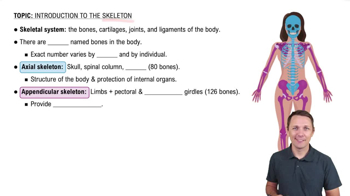
Includes the skull, vertebrae, ribs, and sternum.
Frontal bone key feature
Contains the
supraorbital foramina
above the eye sockets.
Temporal bone important markings
Includes the
external acoustic meatus
,
mastoid process
,
styloid process
,
mandibular fossa
, and
zygomatic process
.
Occipital bone features
Has the
foramen magnum
and
occipital condyles
for skull-spine connection.
Sutures of the skull
Major sutures are
coronal
,
sagittal
,
lambdoid
, and
squamous
.
Sphenoid bone notable parts
Includes the
greater wing
,
lesser wing
,
sella turcica
, and
optic foramina
.
Ethmoid bone key structures
Contains the
perpendicular plate
(upper nasal septum) and
cribriform plate
.
Mandible important landmarks
Features the
mandibular condyle
,
angle
,
ramus
,
alveolar processes
,
mental foramina
, and
mandibular foramina
.
Vomer bone function
Forms the
lower nasal septum
.
Maxilla key features
Has
infraorbital foramina
,
alveolar processes
, and the
palatine process
forming the anterior bony palate.
Zygomatic bone location
Forms the
cheekbone
and part of the orbit.
Vertebrae regions and counts
Cervical
(7),
thoracic
(12),
lumbar
(5),
sacral
(5 fused),
coccygeal
(4 fused).
Common vertebra structures
Include the
body
,
spinous process
,
vertebral foramen
,
transverse processes
, and
intervertebral foramen
.
Atlas (C1) unique features
Lacks a body and has
transverse foramina
.
Axis (C2) special structure
Has the
dens
which allows head rotation.
Rib classifications
True ribs
(1-7),
false ribs
(8-10), and
floating ribs
(11-12).
Sternum parts
Consists of the
manubrium
,
body
, and
xiphoid process
.
Pectoral girdle bones
Includes the
clavicle
and
scapula
.
Clavicle ends
Has the
acromial end
(lateral) and
sternal end
(medial).
Scapula key landmarks
Includes the
spine
,
glenoid cavity
,
acromion
,
coracoid process
, and
subscapular fossa
.
Pelvic girdle bones
Composed of the
sacrum
and paired
os coxa
(ilium, ischium, pubis).
Os coxa important features
Includes the
pubic symphysis
,
pubic crest
,
ischial tuberosity
,
acetabulum
,
iliac crest
, and
iliac fossa
.
Hand bones overview
Contains 8
carpals
, 5
metacarpals
, and 14
phalanges
(thumb has 2, others have 3).
Foot bones overview
Includes
talus
,
calcaneus
, 7
tarsals
, 5
metatarsals
, and 14
phalanges
(big toe has 2, others have 3).
Femur key landmarks
Has the
head
,
neck
,
greater and lesser trochanters
,
patellar surface
, and
medial and lateral condyles
.
Humerus important features
Includes the
head
,
neck
,
greater and lesser tubercles
,
deltoid tuberosity
,
olecranon fossa
,
trochlea
, and
coronoid fossa
.
Ulna distinguishing parts
Has the
olecranon process
,
trochlear notch
,
coronoid process
,
medial and lateral epicondyles
, and
radial notch
.
Radius key features
Includes the
head
,
styloid process
(lateral), and
radial tuberosity
.
 BackBack
 4:50
