Skip to main content
Anatomy & Physiology
My Course
Learn
Exam Prep
AI Tutor
Study Guides
Textbook Solutions
Flashcards
Explore
Try the app
My Course
Learn
Exam Prep
AI Tutor
Study Guides
Textbook Solutions
Flashcards
Explore
Try the app
Back
Anatomy & Physiology I Lab Exam 1 Review
You can tap to flip the card.
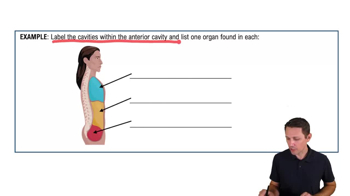
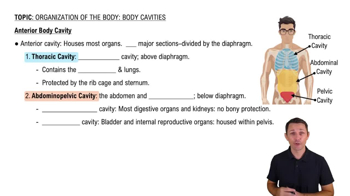
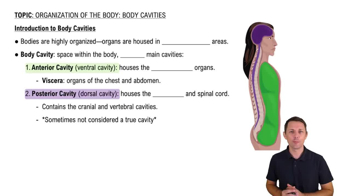
Name three major body cavities.
You can tap to flip the card.
👆
Name three major body cavities.
Body cavities
include the cranial, thoracic, and abdominopelvic cavities.
Track progress
Control buttons has been changed to "navigation" mode.
1/28
Recommended videos
Guided course
3:20
Introduction to Body Cavities
13259
views
292
rank
Guided course
1:40
Organization of the Body: Body Cavities Example 2
7459
views
146
rank
Guided course
3:25
Anterior Body Cavity
8758
views
192
rank
Terms in this set (28)
Hide definitions
Name three major body cavities.
Body cavities
include the cranial, thoracic, and abdominopelvic cavities.
What are the nine regions of the abdomen used for?
The
nine abdominal regions
help localize organs and pain areas in clinical and anatomical contexts.
List five regional terms related to the body surface.
Examples include
sacral
,
gluteal
,
lumbar
,
thoracic
, and
cervical
.
What are the two main layers of the skin?
The skin consists of the
epidermis
(outer layer) and the
dermis
(inner layer).
Name three structures associated with hair.
Hair structures include the
shaft
,
bulb
, and
follicle
.
Identify three types of epithelial tissue.
Types include
simple squamous
,
simple cuboidal
, and
stratified squamous
epithelium.
What are the three types of muscle tissue?
Skeletal
,
cardiac
, and
smooth
muscle tissues.
Name two connective tissues and one cartilage type.
Areolar
and
adipose
connective tissues;
hyaline cartilage
as a cartilage type.
What is the function of the neuron?
A
neuron
transmits electrical signals in the nervous system.
Name two sutures found on the parietal bone.
The
sagittal
and
coronal
sutures.
What is the significance of the foramen magnum?
The
foramen magnum
is the large opening in the occipital bone for the spinal cord to connect to the brain.
Identify two processes on the temporal bone.
The
styloid process
and the
mastoid process
.
What bones form the zygomatic arch?
The
zygomatic process
of the temporal bone and the
zygomatic bone
.
How many cervical vertebrae are there and name two special ones.
There are
7 cervical vertebrae
, including the
atlas
and
axis
.
What distinguishes true ribs from false ribs?
True ribs
(7 pairs) attach directly to the sternum;
false ribs
(5 pairs) do not, with 2 floating ribs among them.
Name three parts of the sternum.
The
manubrium
,
body
, and
xiphoid process
.
What is the function of the acromion process on the scapula?
The
acromion process
forms the highest point of the shoulder and articulates with the clavicle.
Name two fossae found on the scapula.
The
supraspinous fossa
and
infraspinous fossa
.
Identify two features of the humerus.
The
head
and the
greater tubercle
.
What are the three parts of the pelvic bone?
The
ilium
,
ischium
, and
pubis
.
Name two landmarks on the ilium.
The
anterior superior iliac spine (ASIS)
and the
iliac crest
.
What is the acetabulum?
The
acetabulum
is the socket in the pelvis that articulates with the femur head.
Name two features of the femur.
The
greater trochanter
and the
medial condyle
.
What bone contains the tibial tuberosity?
The
tibia
contains the tibial tuberosity.
Which bone forms the lateral malleolus?
The
fibula
forms the lateral malleolus.
How many carpals and tarsals are there?
There are
8 carpals
in the wrist and
7 tarsals
in the ankle.
Name two tarsal bones.
The
talus
and the
calcaneus
.
What are the three types of phalanges?
The
distal
,
middle
, and
proximal
phalanges.
 BackBack
 3:20