 Back
Anatomy & Physiology: Joints and Movements
 01:43

Terms in this set (28)
A joint is a site where two or more bones meet, allowing varying degrees of movement.
Structurally, joints are classified as fibrous, cartilaginous, or synovial based on what holds the joint together and presence of a cavity.
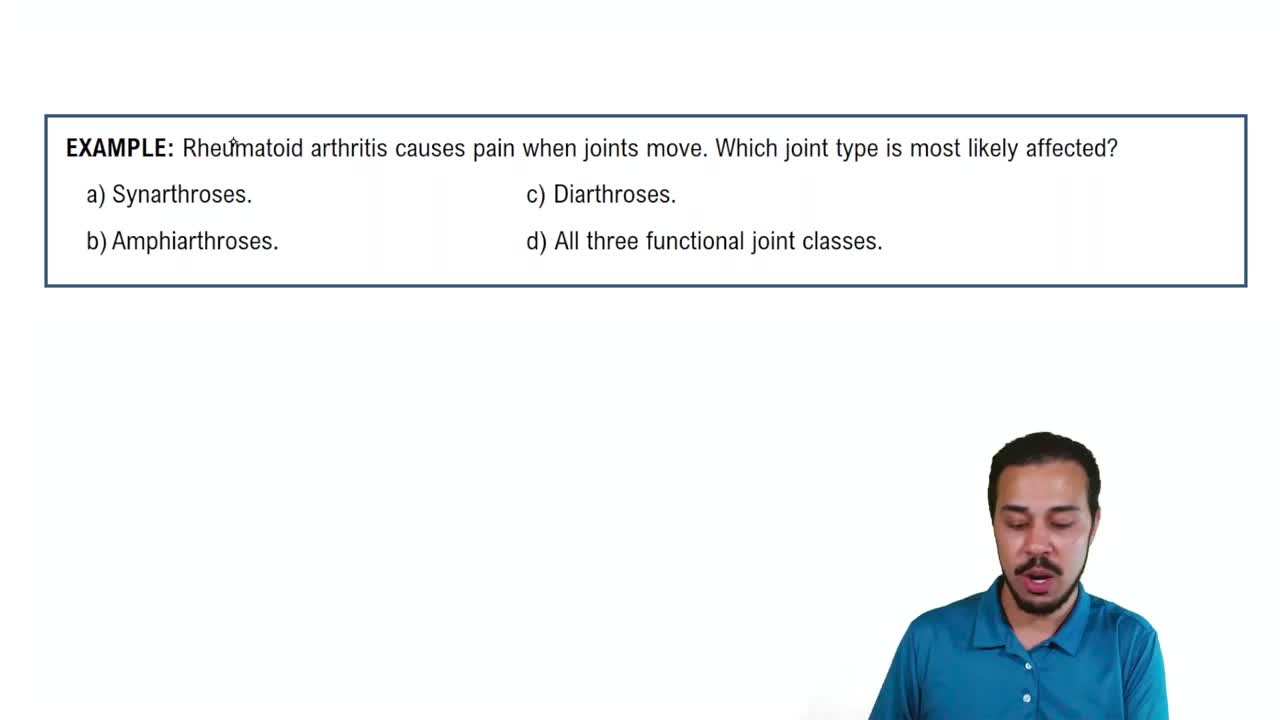
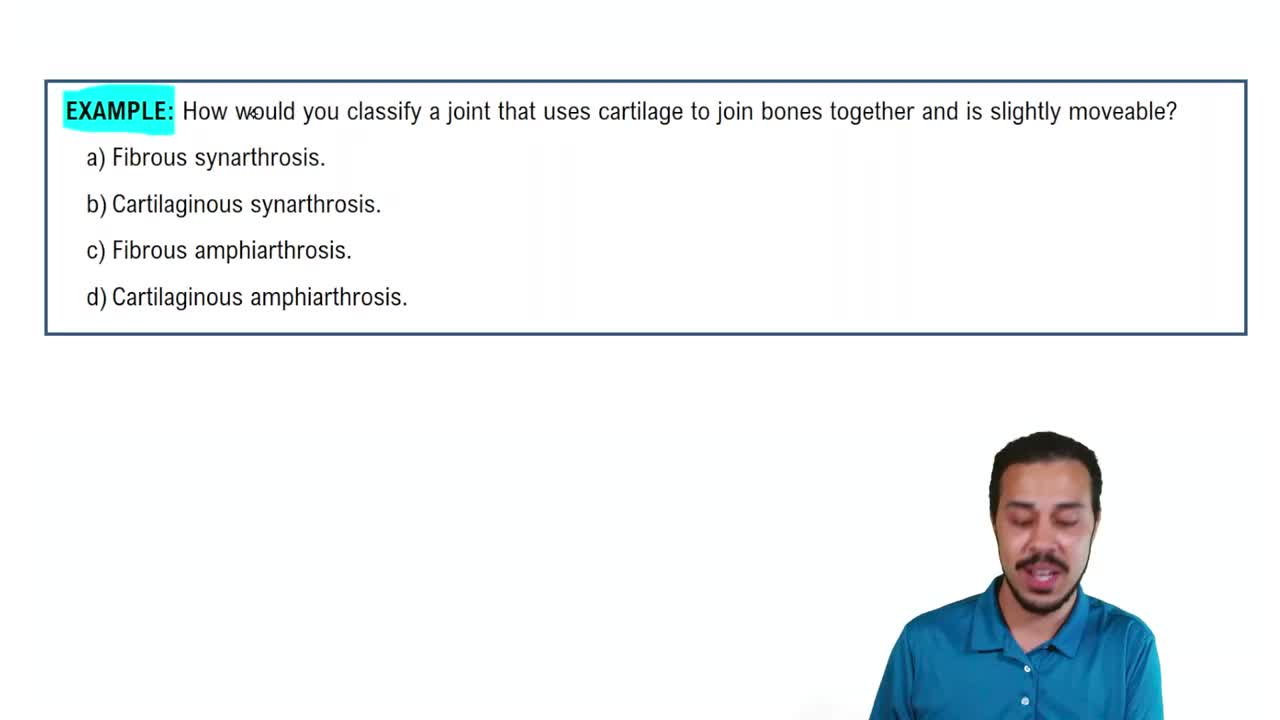
Functionally, joints are classified as synarthroses (immovable), amphiarthroses (slightly movable), or diarthroses (freely movable).
Fibrous joints are joined by fibrous connective tissue, have no joint cavity, and allow little to no movement.
Sutures (no movement), syndesmoses (limited movement), and gomphoses (peg-in-socket, e.g., tooth socket).
Cartilaginous joints unite bones with cartilage, lack a joint cavity, and allow limited movement.
Synchondroses are joints with hyaline cartilage (e.g., epiphyseal plates). Symphyses have fibrocartilage linking bones (e.g., pubic symphysis).
Articular cartilage, joint cavity, articular capsule, synovial fluid, reinforcing ligaments, nerves and blood vessels.
Synovial fluid fills the joint cavity, reducing friction and cushioning the joint.
Bursae are sacs of synovial fluid reducing friction where tissues rub bones; tendon sheaths are elongated bursae around tendons.
Articular surface shape, number and tension of ligaments, and muscle tone stabilizing tendons.
Cartilage injuries, especially in the knee, heal slowly due to poor blood supply and may require arthroscopic surgery.
Dislocation: bones forced out of position; sprain: ligament tear, partial heals slowly, complete may need surgery.
Nonaxial (gliding), uniaxial (one plane), biaxial (two planes), and multiaxial (multiple planes) movements.
A plane joint has flat surfaces allowing gliding movements, e.g., intercarpal joints.
A hinge joint allows flexion and extension, e.g., elbow joint.
A pivot joint allows rotation around a single axis, e.g., proximal radioulnar joint.
A condylar joint has oval articular surfaces allowing movement in two planes, e.g., knuckle joints.
A saddle joint resembles a rider in a saddle, permitting greater freedom than condylar joints, e.g., thumb joint.
Ball-and-socket joints allow multiaxial movement, e.g., shoulder and hip joints.
Anterior and posterior cruciate ligaments (intracapsular), fibular and tibial collateral ligaments (extracapsular), and menisci.
The elbow is a hinge joint stabilized by collateral ligaments and the annular ligament, allowing flexion, extension, and rotation of the radius.
Rotator cuff tendons provide main stability; coracohumeral ligament and glenoid labrum also contribute.
Ligamentum teres connects femur head to acetabulum; its artery may affect hip joint health but function is unclear.
TMJ allows hinge movement for jaw opening and sliding for side-to-side motion, stabilized by a lateral ligament and articular disc.
Opposition is the movement of the thumb to touch fingertips, enabling grasping.
Protraction moves the mandible forward; retraction moves it backward.
Elevation raises the mandible (closing the mouth); depression lowers it (opening the mouth).