 Back
BackAnatomy & Physiology Key Concepts
 3:55
3:55
Terms in this set (30)
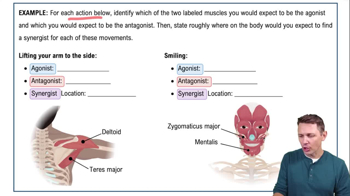
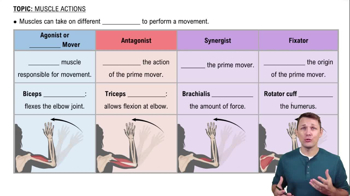
Functions of prime movers
Prime movers cause the main movement
Functions of antagonists
antagonists oppose the movement
Functions of synergists
synergists assist the prime movers by stabilizing joints or adding extra force
determines the direction and type of movement it produces when it contracts.
Muscles are named by location, shape, size, direction of fibers, number of origins, location of attachments, and action.
Definition of a lever in the musculoskeletal system
A lever is a rigid structure (bone) that moves on a fixed point (fulcrum) when force (effort) is applied to overcome a load (resistance).
mechanical advantage moves a large load with less effort/ mechanical disadvantage, more effort moves a smaller load faster or farther.
First-class: fulcrum between effort and load.
Second-class: load between fulcrum and effort
Third-class: effort between fulcrum and load.
The nervous system receives, integrates, and responds to sensory information to maintain homeostasis and coordinate body functions.
Central nervous system (CNS): brain and spinal cord.
Peripheral nervous system (PNS): all nerves outside the CNS.
Neuroglia support neurons by protecting, nourishing, insulating, and maintaining the environment arou`1nd neurons.
A neuron is a nerve cell with a cell body, dendrites (receive signals), and an axon (sends signals).
A nucleus is a cluster of neuron cell bodies in the CNS; a ganglion is a cluster in the PNS.
A nerve is a bundle of axons in the PNS; a tract is a bundle of axons in the CNS.
The myelin sheath insulates axons to speed signal conduction; formed by oligodendrocytes in CNS and Schwann cells in PNS.
By structure: multipolar, bipolar, unipolar. By function: sensory, motor, and interneurons.
Current is flow of ions, voltage is electrical potential difference, and resistance opposes current flow.
Include leak channels, gated channels (voltage-, ligand-, mechanically-gated), which regulate ion flow across membranes.
The resting membrane potential is the voltage across the membrane at rest, caused by ion concentration differences and selective permeability.
Graded potentials are short, localized changes in membrane potential, such as postsynaptic potentials and receptor potentials.
Graded potentials vary in size and decay with distance; action potentials are all-or-none, propagate without loss, and travel long distances.
Action potentials are generated by voltage-gated Na+ channels opening, depolarizing the membrane, and propagated along the axon by sequential channel activation.
Absolute refractory period: no new action potential possible.
Relative refractory period: a stronger stimulus can trigger an action potential.
Saltatory conduction occurs in myelinated axons, where impulses jump between nodes of Ranvier, speeding transmission compared to continuous conduction.
A synapse is a junction where neurons communicate via neurotransmitter release or electrical coupling.
Electrical synapses use gap junctions for direct ion flow; chemical synapses use neurotransmitters to transmit signals across a synaptic cleft.
Excitatory postsynaptic potentials (EPSPs) depolarize the membrane; inhibitory postsynaptic potentials (IPSPs) hyperpolarize it.
Neurons integrate multiple synaptic inputs through summation, which can be spatial or temporal, modifying the postsynaptic response.
Neurotransmitters are chemical messengers classified by structure (e.g., amino acids, amines) and function (excitatory, inhibitory, modulatory).
At channel-linked receptors, neurotransmitters open ion channels; at G protein–coupled receptors, they activate signaling cascades.