Skip to main content
Anatomy & Physiology
My Course
Learn
Exam Prep
AI Tutor
Study Guides
Textbook Solutions
Flashcards
Explore
Try the app
My Course
Learn
Exam Prep
AI Tutor
Study Guides
Textbook Solutions
Flashcards
Explore
Try the app
Back
Anatomy & Physiology Lab 1 & 2 Key Terms
You can tap to flip the card.
Midsagittal plane
You can tap to flip the card.
👆
Midsagittal plane
A vertical plane that divides the body into equal right and left halves.
Track progress
Control buttons has been changed to "navigation" mode.
1/34
Recommended videos
Guided course
04:01
Anatomical Planes
11326
views
202
rank
Guided course
02:06
Anatomical Planes & Sections Example 1
7906
views
143
rank
Guided course
01:57
Anatomical Planes & Sections Example 2
7003
views
110
rank
1
comments
Terms in this set (34)
Hide definitions
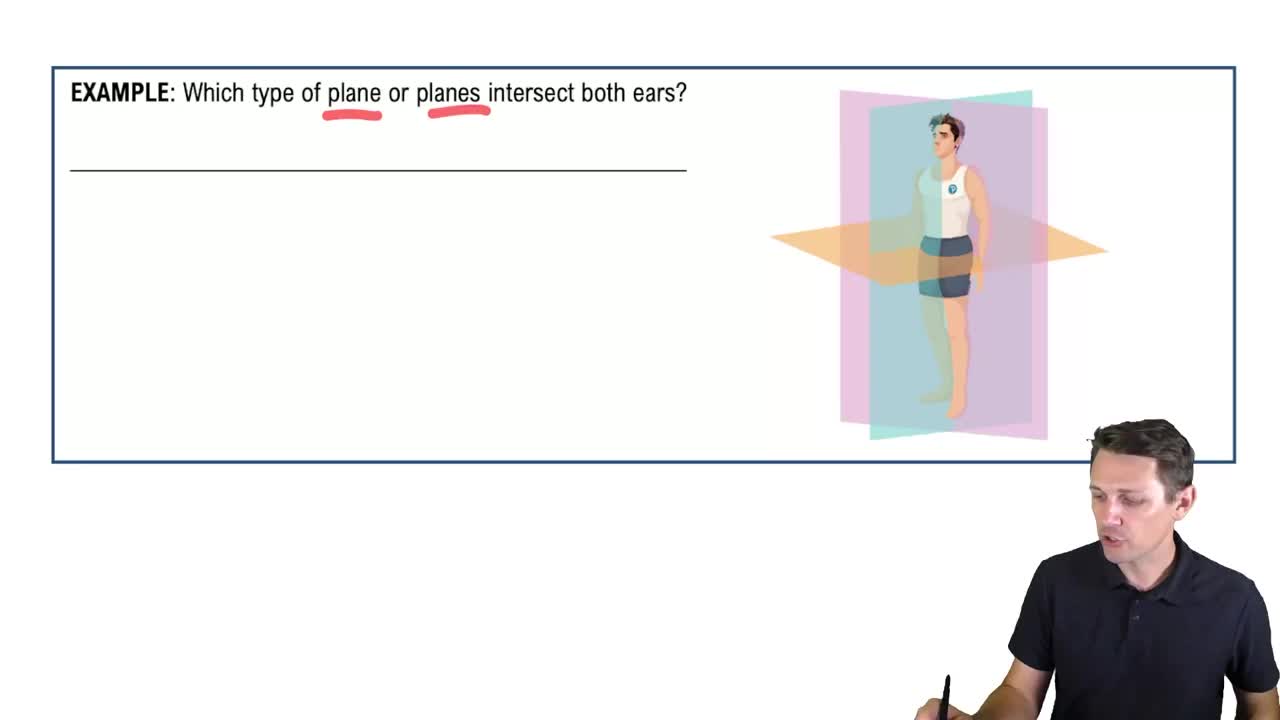
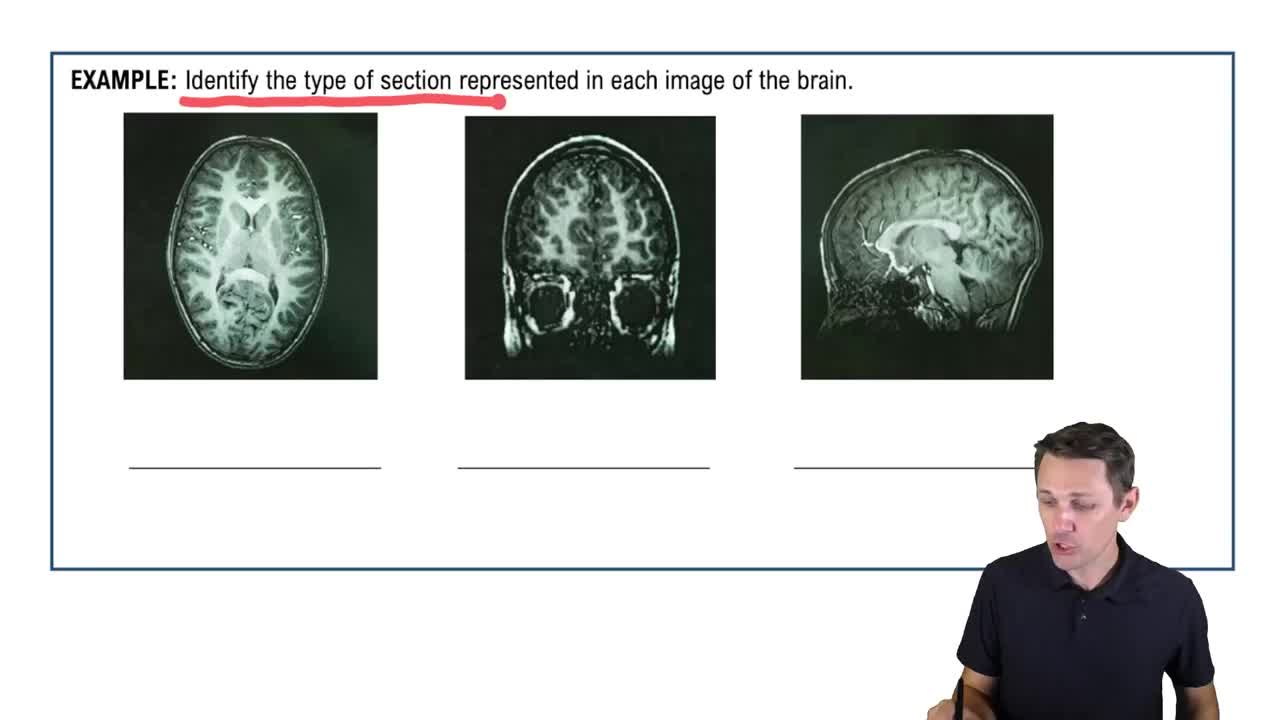
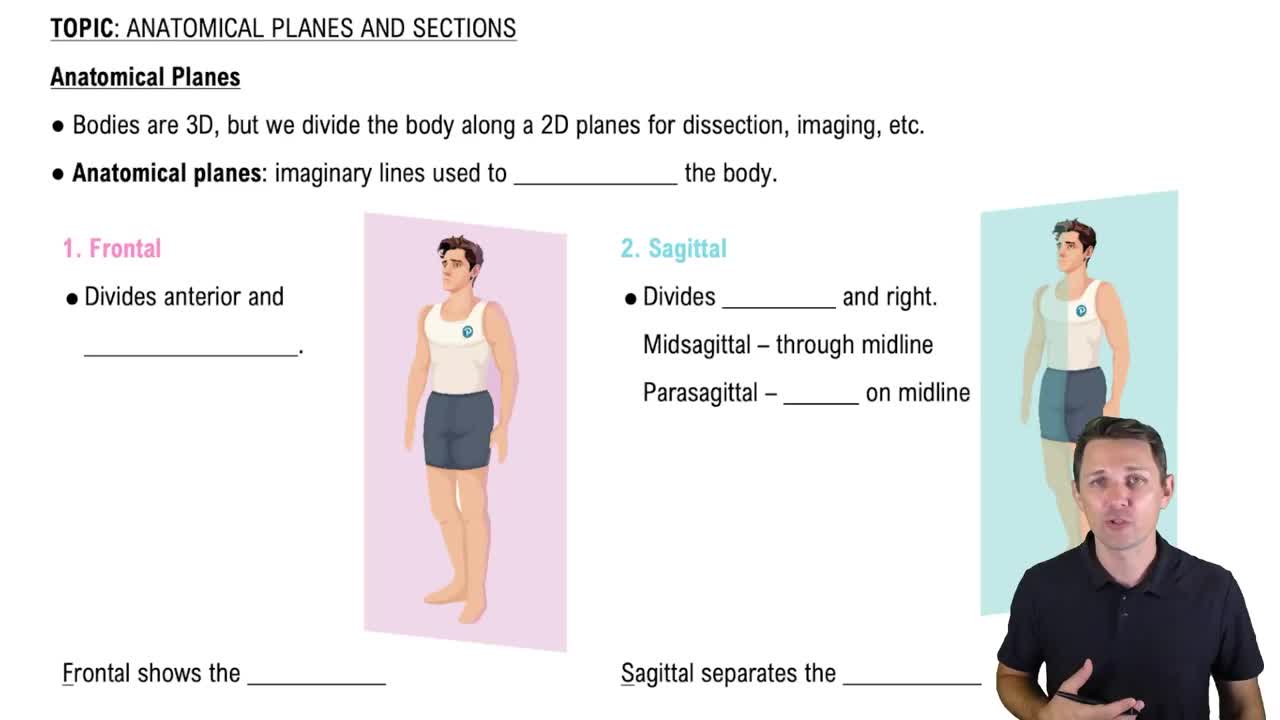
Midsagittal plane
A vertical plane that divides the body into equal right and left halves.
Frontal plane
A vertical plane that divides the body into anterior (front) and posterior (back) sections.
Transverse plane
A horizontal plane that divides the body into superior (upper) and inferior (lower) parts.
Superior
Refers to a structure being above or higher than another structure.
Inferior
Refers to a structure being below or lower than another structure.
Medial
Toward the midline of the body.
Lateral
Away from the midline of the body.
Proximal
Closer to the point of attachment or origin.
Distal
Farther from the point of attachment or origin.
Superficial
Closer to or on the surface of the body.
Deep
Farther away from the surface of the body.
Anterior (Ventral)
Toward the front of the body.
Posterior (Dorsal)
Toward the back of the body.
Cephalic
Relating to the head.
Mental
Relating to the chin.
Sural
Relating to the calf of the leg.
Palmar
Relating to the palm of the hand.
Cervical
Relating to the neck region.
Thoracic cavity
The body cavity located within the chest, housing the heart and lungs.
Abdominal cavity
The body cavity containing digestive organs such as the stomach, intestines, liver, and others.
Simple squamous epithelium
A single layer of flat cells that allows for rapid diffusion and filtration; found in lungs and blood vessels.
Simple cuboidal epithelium
A single layer of cube-shaped cells involved in secretion and absorption; found in kidney tubules and glands.
Simple columnar epithelium
A single layer of tall, column-shaped cells that absorb and secrete mucus; found in the digestive tract.
Nonkeratinized stratified squamous epithelium
Multiple layers of flat cells that protect underlying tissues; found in moist areas like the mouth and esophagus.
Pseudostratified ciliated columnar epithelium
A single layer of cells with varying heights, often ciliated; functions in secretion and movement of mucus; found in respiratory tract.
Transitional epithelium
Multiple layers of cells that can stretch; found lining the urinary bladder.
Areolar connective tissue
Loose connective tissue that cushions organs and provides support; contains collagen and elastic fibers.
Reticular connective tissue
Network of reticular fibers that supports lymphoid organs like the spleen and lymph nodes.
Adipose tissue
Connective tissue specialized for fat storage and insulation.
Dense regular connective tissue
Tightly packed collagen fibers arranged in parallel; provides strong attachment; found in tendons and ligaments.
Dense irregular connective tissue
Collagen fibers arranged irregularly; provides strength in multiple directions; found in dermis of skin.
Hyaline cartilage
Smooth cartilage that reduces friction and supports; found on joint surfaces and respiratory structures.
Fibrocartilage
Tough cartilage with thick collagen fibers; found in intervertebral discs and pubic symphysis.
Elastic cartilage
Cartilage with elastic fibers; provides flexible support; found in ear and epiglottis.
 BackBack
 04:01