Skip to main content
Anatomy & Physiology
My Course
Learn
Exam Prep
AI Tutor
Study Guides
Textbook Solutions
Flashcards
Explore
Try the app
My Course
Learn
Exam Prep
AI Tutor
Study Guides
Textbook Solutions
Flashcards
Explore
Try the app
Back
Anatomy & Physiology Lab Practical 1 Key Concepts
You can tap to flip the card.
Thyroid hormones
You can tap to flip the card.
👆
Thyroid hormones
T3 and T4 regulate metabolism. Their secretion is controlled by the hypothalamus and pituitary via TSH.
Track progress
Control buttons has been changed to "navigation" mode.
1/29
Recommended videos
Guided course
7:06
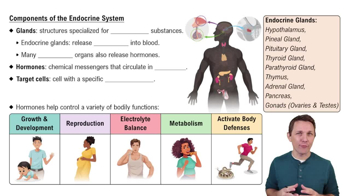
Components of the Endocrine System
15432
views
458
rank
Guided course
6:20
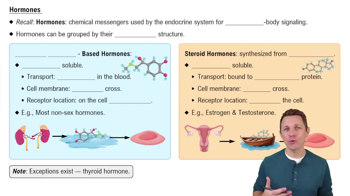
Hormones
11759
views
286
rank
Guided course
3:33
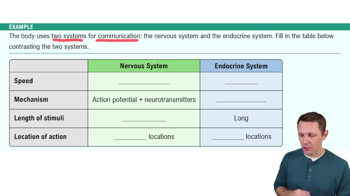
Introduction to the Endocrine System Example 1
16546
views
491
rank
1
comments
Terms in this set (29)
Hide definitions
Thyroid hormones
T3 and T4 regulate metabolism. Their secretion is controlled by the hypothalamus and pituitary via TSH.
Hyperthyroid vs. Hypothyroid
Hyperthyroid means excess thyroid hormone; hypothyroid means deficiency; euthyroid is normal thyroid function.
Metabolic rate calculation
Metabolic rate is calculated in ml O2/min/gram to assess oxygen consumption.
Formed elements of blood
Includes red blood cells (RBCs), white blood cells (WBCs), and platelets, each with distinct functions.
Hematocrit
The percentage of RBCs in whole blood; inversely related to plasma percentage.
Blood volume calculation
Determined using hematocrit and plasma volume measurements.
Hemoglobin function
Carries oxygen in RBCs; its content determines oxygen carrying capacity.
Heart blood flow
Blood flows from body to right atrium, right ventricle, lungs, left atrium, left ventricle, then body.
Intercalated discs in cardiac muscle
Contain desmosomes and gap junctions for mechanical and electrical coupling.
ECG and cardiac cycle
ECG waves correspond to electrical events triggering heart contractions.
Artery vs. vein histology
Arteries have thicker muscular walls; veins have valves and thinner walls.
Elastic arteries
Large arteries with elastic fibers to stretch and recoil, maintaining blood pressure.
Muscular arteries
Distribute blood to specific body regions; have more smooth muscle.
Capillaries
Microscopic vessels where gas and nutrient exchange occurs.
Hepatic portal system
Carries blood from digestive organs to the liver for processing.
Fetal circulation
Includes shunts like the ductus arteriosus to bypass lungs before birth.
Mean arterial pressure (MAP)
Average blood pressure during a cardiac cycle; calculated from systolic and diastolic pressures.
Pulse pressure
Difference between systolic and diastolic blood pressure.
Cardiac output
Volume of blood pumped by the heart per minute; calculated as heart rate × stroke volume.
Lymphatic system functions
Returns interstitial fluid to blood, filters pathogens, and supports immune responses.
Thymus function
Site of T cell maturation in the immune system.
Spleen function
Filters blood, recycles RBCs, and helps fight infections.
Lymph nodes
Filter lymph and house immune cells to detect pathogens.
MALT
Mucosa-associated lymphoid tissue protects mucous membranes from pathogens.
RID assay
Radial immunodiffusion assay measures concentration of specific proteins or antibodies.
Conducting vs. respiratory structures
Conducting airways transport air; respiratory structures enable gas exchange.
Trachea histology
Contains ciliated pseudostratified epithelium and cartilage rings for support.
Lung histology
Composed of alveoli lined by simple squamous epithelium for gas exchange.
Lung volumes and capacities
Measured by spirometry to assess respiratory function.
 BackBack
 7:06