Skip to main content
Anatomy & Physiology
My Course
Learn
Exam Prep
AI Tutor
Study Guides
Textbook Solutions
Flashcards
Explore
Try the app
My Course
Learn
Exam Prep
AI Tutor
Study Guides
Textbook Solutions
Flashcards
Explore
Try the app
Back
Anatomy & Physiology Lecture Exam Set 1
You can tap to flip the card.
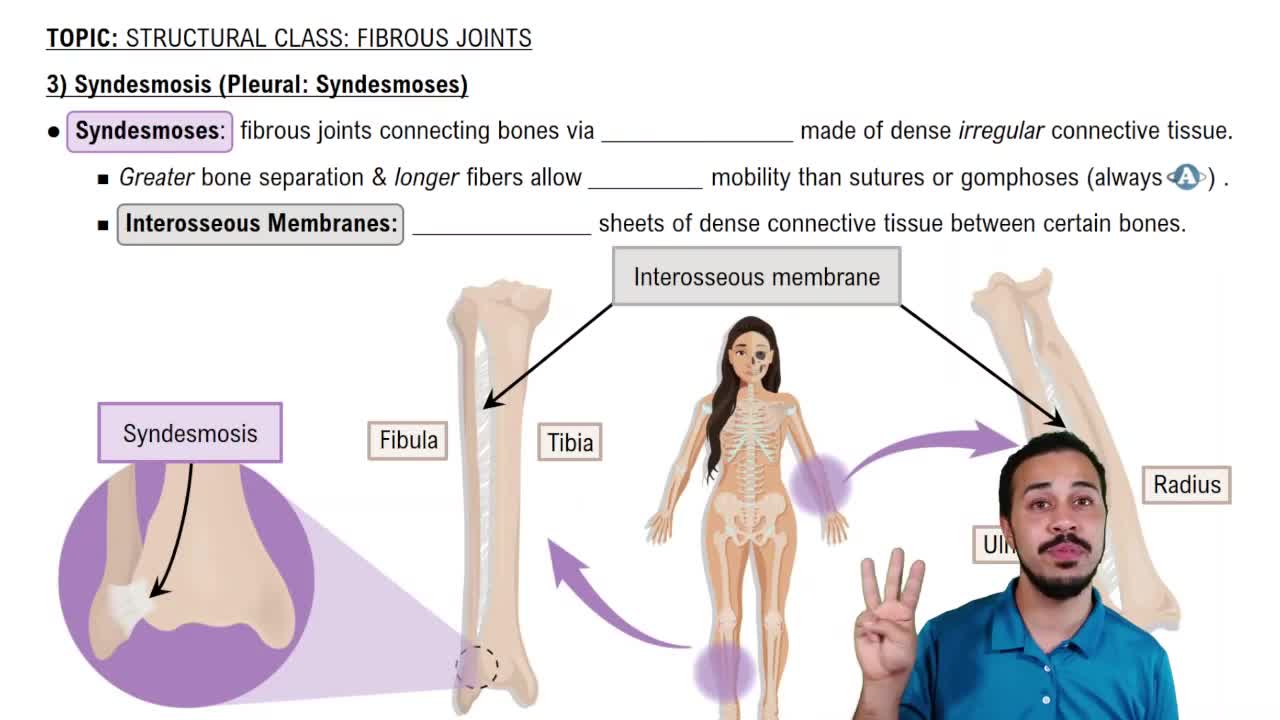
What connects bones in a syndesmosis fibrous joint?
You can tap to flip the card.
👆
What connects bones in a syndesmosis fibrous joint?
Ligaments
connect bones in a syndesmosis fibrous joint.
Track progress
Control buttons has been changed to "navigation" mode.
1/18
Recommended videos
Guided course
07:31
Sutures
10494
views
185
rank
Guided course
02:23
Structural Class: Fibrous Joints Example 2
7195
views
125
rank
Guided course
04:28
Syndesmosis (Pleural: Syndesmoses)
8896
views
149
rank
Terms in this set (18)
Hide definitions
What connects bones in a syndesmosis fibrous joint?
Ligaments
connect bones in a syndesmosis fibrous joint.
What lubricates synovial joints to reduce friction?
Synovial fluid
lubricates synovial joints and reduces friction.
Which muscle type produces more tension due to more muscle fibers?
Pennate muscles
typically produce more tension because they have more muscle fibers.
Which muscles are stretched and relaxed when the prime mover is active?
Antagonists
are stretched and relaxed when the prime mover (agonist) is active.
What causes the striated appearance of cardiac muscle?
The striated appearance is primarily due to the
arrangement of contractile proteins
.
Which activity is sustained by Type I (slow-twitch oxidative) muscle fibers?
Long-distance running
is sustained by Type I slow-twitch oxidative fibers.
During muscle contraction, what happens to the Z-discs in the sarcomere?
The
Z-discs move closer together
as the sarcomere shortens during contraction.
What happens if a sarcomere exceeds its ideal length?
Less tension is produced
if the sarcomere is stretched beyond its ideal length.
Which connective tissue surrounds an entire nerve and contains fascicles?
Epineurium
surrounds an entire nerve and contains numerous fascicles.
What is a shift in membrane potential toward a more positive value called?
Depolarization
is a shift in membrane potential toward a more positive value.
What happens when an EPSP reaches threshold in a postsynaptic neuron?
An
action potential will be generated
when EPSP reaches threshold.
At rest, how is the inside of a neuron charged compared to the outside?
The inside of a resting neuron is
more negative than the outside
.
How are dermatomes useful in diagnosing nerve injuries?
Dermatomes are
innervated by sensory fibers of a particular nerve
, helping localize nerve injuries.
What is the integration center for reflex arcs where afferent neurons synapse?
The
spinal cord
acts as the integration center for reflex arcs.
Which nervous system activity explains increased salivation and hunger from smelling food?
The
parasympathetic nervous system
controls salivation and hunger responses.
What effect might excessive dosage of a pill blocking glycine receptors cause?
It may cause
muscle spasms
due to loss of inhibitory neurotransmission.
What happens to the sympathetic nervous system activity after exercise?
The
sympathetic nervous system activity increases
after exercise.
Where are postganglionic sympathetic fibers found in the ANS?
They are found in the
gray rami communicantes
.
 BackBack
 07:31