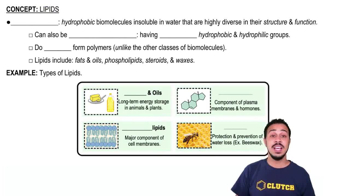
Lipids contain carbon (C), hydrogen (H), oxygen (O), but less oxygen than carbohydrates, and sometimes phosphorus (P).
What are the main types of lipids?
The main types of lipids are triglycerides, phospholipids, steroids, and eicosanoids.
What is the structure of triglycerides?
Triglycerides are composed of three fatty acids bonded to a glycerol molecule by dehydration synthesis.
What are the main functions of triglycerides?
Triglycerides function in energy storage, insulation, and protection.
What distinguishes saturated fatty acids in triglycerides?
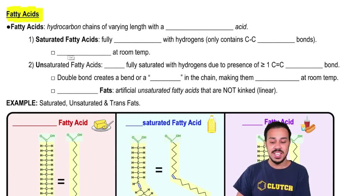
Saturated fatty acids have all carbons linked by single covalent bonds, are saturated with hydrogen, and form linear molecules that are solid at room temperature.
How do unsaturated fatty acids differ from saturated ones?
Unsaturated fatty acids have one or more double bonds between carbons, reducing hydrogen atoms and causing kinks that prevent tight packing.
What are trans fats and omega-3 fatty acids?
Trans fats are modified unsaturated fats resembling saturated fats and are unhealthy; omega-3 fatty acids are heart-healthy unsaturated fats.
What is the structure of phospholipids?
Phospholipids are modified triglycerides with two fatty acids and a phosphorus-containing group, having a polar hydrophilic head and nonpolar hydrophobic tails.
Why are phospholipids important in cell membranes?
Phospholipids form a bilayer with hydrophilic heads facing water and hydrophobic tails inside, creating a selective membrane barrier.
What is the structure of steroids?
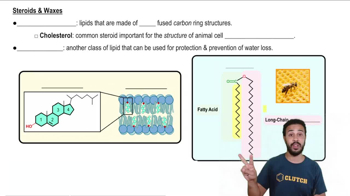
Steroids consist of four interlocking hydrocarbon rings with cholesterol as the most important example.
What roles does cholesterol play in the body?
Cholesterol is a precursor for vitamin D, steroid hormones, bile salts, and is important in cell plasma membrane structure.
What are eicosanoids and their functions?
Eicosanoids are derived from arachidonic acid and include prostaglandins that regulate blood clotting, blood pressure, inflammation, and labor contractions.
How do NSAIDs affect eicosanoids?
NSAIDs like aspirin block the inflammatory actions of eicosanoids, reducing pain and inflammation.
What elements do proteins contain?
Proteins contain carbon (C), hydrogen (H), oxygen (O), nitrogen (N), and sometimes sulfur (S) and phosphorus (P).
What are proteins made of?
Proteins are polymers of amino acid monomers linked by peptide bonds.
What determines a protein's function?
A protein's function is defined by its shape; proteins out of shape cannot function properly.
How many types of amino acids are there?
There are 20 different types of amino acids that make up all proteins.
What are the four levels of protein structure?
Protein structure levels are: primary (amino acid sequence), secondary (alpha helices and beta sheets), tertiary (3D folding), and quaternary (interaction of multiple polypeptides).
What is the function of structural proteins?
Structural proteins like collagen provide mechanical support and tensile strength to tissues.
What is the role of enzyme proteins?
Enzyme proteins catalyze biochemical reactions, such as disaccharidases hydrolyzing disaccharides and oxidases oxidizing food fuels.
 Back
 03:31