 Back
Anatomy & Physiology: Lymphatic & Immune System
 3:32

Terms in this set (25)
Immunity is the body's ability to resist infection and disease caused by pathogens or abnormal cells.
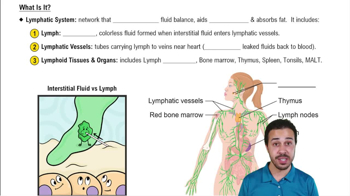
Lymph, lymphatic vessels, lymph nodes, lymphatic tissues and organs, and lymphocytes.
Red bone marrow and thymus, where lymphocytes are formed and mature.
Tonsils, MALT, lymph nodes, and spleen where lymphocytes are activated to start an immune response.
T cells, B cells, and NK (Natural Killer) cells.
In the red bone marrow.
In the thymus.
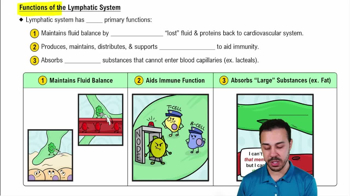
Interstitial fluid enters lymphatic capillaries during blood capillary exchange and becomes lymph.
Filter lymph to remove pathogens and cancer cells; contain B, T, and NK cells that attack threats.
Lymphatic capillaries → lymph nodes → lymphatic trunks → collecting ducts → subclavian veins (blood circulation).
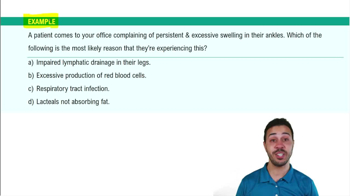
Swelling caused by obstruction of lymphatic vessels, increasing risk of infection.
Mucosa-associated lymphatic tissue found in mucous membranes of digestive, respiratory, urinary, and reproductive tracts.
Development and maintenance of T cells; active mainly in early life and shrinks after puberty.
Physical barriers, phagocytes, NK cells, interferons, complement, inflammation, and fever.
Innate immunity is nonspecific and present at birth; adaptive immunity is specific and develops after exposure to pathogens.
By secreting perforins that create holes in the plasma membrane, causing cell death.
The display of antigens on cell membranes to help the immune system distinguish self from non-self.
Cytotoxic T cells attack infected cells; Helper T cells activate B and T cells; Regulatory T cells moderate responses; Memory T cells remember antigens.
Active immunity produces antibodies by the body after exposure; passive immunity receives antibodies from another source.
IgG (most abundant, crosses placenta), IgE (allergic responses), IgD (binds extracellular antigens), IgM (first antibody produced), IgA (found in secretions).
Initial exposure activates B cells to produce antibodies and memory B cells; antibody levels peak after 1-2 weeks.
Memory B cells respond immediately, producing more antibodies faster and in higher quantities.
Allergens trigger IgE to stimulate mast cells to release histamine, causing inflammation and allergic symptoms.
Conditions where autoantibodies attack the body's own tissues, e.g., lupus, rheumatoid arthritis, type 1 diabetes.
Decreased T cell responsiveness, reduced helper T cells, slower antibody production, and diminished immune surveillance increase infection and cancer risk.