 Back
Anatomy & Physiology: Membrane Transport and Cell Environment
 02:26

Terms in this set (19)
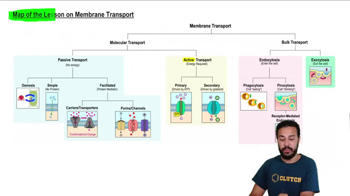
Passive transport is the movement of substances across a membrane without using ATP, often carrier mediated or by diffusion.
Facilitated diffusion is carrier-mediated diffusion using membrane proteins to transport larger molecules and water-soluble ions without ATP.
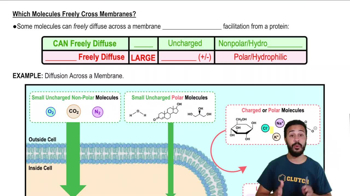
Simple diffusion allows small molecules, lipid-soluble substances, and dissolved gases to pass through the membrane.
Osmosis is the diffusion of water from an area of high concentration to low concentration across a membrane.
Factors include size of molecules, charge, and availability of channels.
Diffusion is affected by size of molecules, temperature, electrical forces, and the concentration gradient.
The cytosol has high potassium, low protein, and some glycogen.
Red blood cells lack a nucleus, so they cannot synthesize proteins, limiting their lifespan.
Cells in a hypotonic solution gain water and may burst (hemolysis).
Cells in a hypertonic solution lose water and undergo crenation (shrink).
Tonicity describes how a solution affects the size of a cell.
Osmolarity is the total concentration of dissolved particles in a solution.
Carrier-mediated transport involves carriers that bind specific molecules to move them across membranes.
Saturation occurs when carriers are full, limiting the rate of transport across the membrane.
It is regulated by cofactors such as hormones.
Cotransport moves two substances in the same direction across a membrane.
Countertransport moves one substance in and another out of the cell simultaneously.
0.9% concentration is isotonic where red blood cells do not change shape.
0.1% is hypotonic; 10% is hypertonic relative to red blood cells.