 Back
Anatomy & Physiology: Membrane Transport Processes
 02:44

Terms in this set (15)
Selective permeability is when the membrane only allows certain molecules that pass a criteria to pass through.
Passive transport requires no cellular energy and moves molecules down their concentration gradient. Active transport requires energy from ATP to move molecules against their gradient.
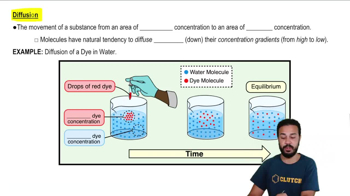
Diffusion is the movement of particles from an area of higher concentration to an area of lower concentration.
Simple diffusion is passive movement of molecules directly through the membrane. Facilitated diffusion uses proteins to help molecules that cannot pass due to size, charge, or polarity.
Osmosis is the diffusion of water across a semipermeable membrane.
Isotonic: equal solute concentration. Hypotonic: lower solute concentration, causes cells to swell. Hypertonic: higher solute concentration, causes cells to shrink.
Vesicular transport is active transport moving substances in/out of the cell via membrane-bound vesicles.
cell engulfs or eats materials
Brings fluid into the cell with membrane bound vesicles (drinks)
Receptor-mediated endocytosis is bringing substances in with specific receptors.
Exocytosis is the process of exporting materials out of the cell using vesicular transport.
Passive transport and active transport are responsible for movement across the plasma membrane.
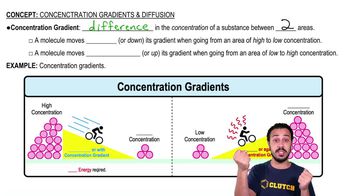
The driving force for passive transport is the concentration gradient, the difference in concentration across a space.
The driving force for active transport is the electrical gradient, a difference in electrical charge across a space.
Substances move from areas of higher concentration to areas of lower concentration.