 Back
Anatomy & Physiology: Muscle and Nervous System Fundamentals
 6:31

Terms in this set (27)
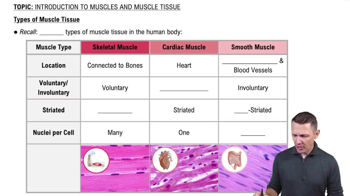
Skeletal (striated, voluntary), Cardiac (striated, involuntary), and Smooth (non-striated, involuntary).
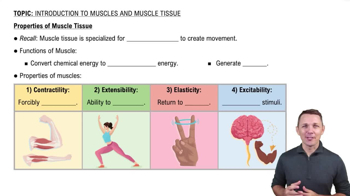
Excitability, Contractility, Extensibility, and Elasticity.
Produce movement, maintain posture, stabilize joints, and generate heat.
Epimysium surrounds entire muscle, Perimysium surrounds fascicles, Endomysium surrounds individual muscle fibers.
Direct: epimysium fused to bone periosteum; Indirect: connective tissue extends as tendon or aponeurosis.
Smallest contractile unit of muscle fiber, extends from one Z disc to the next.
Thick filaments made of myosin; Thin filaments made of actin, tropomyosin, and troponin.
Elastic filament that holds thick filaments in place and helps recoil after stretch.
Stores and releases Ca2+ to regulate intracellular calcium levels for muscle contraction.
Transmit action potentials deep into muscle fiber to trigger Ca2+ release from sarcoplasmic reticulum.
Thin filaments slide past thick filaments, increasing overlap and shortening sarcomere without changing filament length.
1. Cross bridge formation, 2. Power stroke, 3. Cross bridge detachment, 4. Cocking of myosin head.
Motor neuron releases ACh, which binds sarcolemma receptors, triggering action potential and muscle contraction.
1. End plate potential (ACh opens Na+ channels), 2. Depolarization (voltage-gated Na+ channels open), 3. Repolarization (K+ channels open).
AP propagates along sarcolemma and T tubules, triggering Ca2+ release from SR, leading to contraction.
A motor neuron and all the muscle fibers it innervates; smaller units allow finer control.
Latent period (E-C coupling), contraction phase (cross bridge formation), relaxation phase (Ca2+ reuptake).
Multiple stimuli in rapid succession cause increased muscle tension due to incomplete relaxation.
Isotonic: muscle changes length and moves load; Isometric: muscle tension increases but length stays the same.
Direct phosphorylation by creatine phosphate, anaerobic glycolysis, and aerobic respiration.
Glucose broken down to pyruvic acid without oxygen, producing 2 ATP and lactic acid.
Uses oxygen to break down glucose into CO2, H2O, and produces ~32 ATP.
Ionic imbalances (K+, Ca2+, Pi) interfering with excitation-contraction coupling; lack of ATP is rare cause.
Extra oxygen needed after exercise to restore oxygen reserves, convert lactic acid, and replenish ATP and creatine phosphate.
Breaks down ACh to stop muscle contraction and allow relaxation.
Blocks ACh receptors, preventing muscle stimulation and causing paralysis.
ATP depletion after death prevents cross bridge detachment, causing sustained muscle contraction.