 Back
BackAnatomy & Physiology: Muscle Tissue and Contraction
 6:31
6:31
Terms in this set (25)
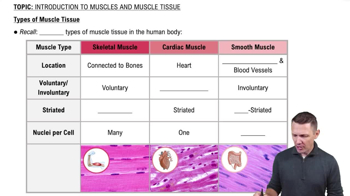
Skeletal, Cardiac, and Smooth muscle tissues.
Long cylindrical fibers, striated, voluntary control, attached to bones and skin, contracts rapidly but tires easily.
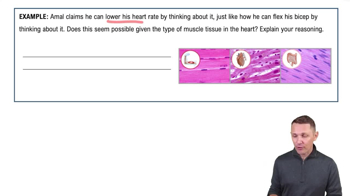
Found only in heart, striated, involuntary, contracts at steady rate due to pacemaker, branching chains of cells.
Found in walls of hollow organs, spindle-shaped cells, nonstriated, involuntary control.
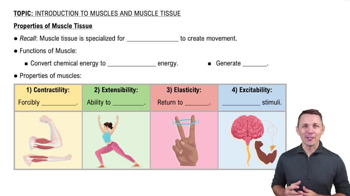
Excitability, contractility, extensibility, and elasticity.
Produce movement, maintain posture, stabilize joints, and generate heat.
Epimysium surrounds entire muscle, perimysium surrounds fascicles, endomysium surrounds individual muscle fibers.
Origin attaches to immovable or less movable bone; insertion attaches to movable bone.
The smallest contractile unit of a muscle fiber, extending from one Z disc to the next.
Thick filaments are made of myosin; thin filaments are made of actin, tropomyosin, and troponin.
Stores and releases Ca2+ ions to trigger muscle contraction.
Transmit electrical impulses deep into muscle fiber to trigger Ca2+ release from SR.
Thin filaments slide past thick filaments, increasing overlap and shortening the sarcomere without changing filament length.
1. Cross bridge formation, 2. Power stroke, 3. Cross bridge detachment, 4. Cocking of myosin head.
AP arrives, Ca2+ enters axon terminal, ACh released, binds to receptors, Na+ enters muscle fiber, end plate potential generated.
End plate potential, depolarization, and repolarization.
Process linking AP propagation along sarcolemma and T tubules to Ca2+ release and muscle contraction.
Isotonic: muscle changes length and moves load; Isometric: muscle tension increases but length stays the same.
Direct phosphorylation by creatine phosphate, anaerobic glycolysis, and aerobic respiration.
Number of fibers stimulated, fiber size, frequency of stimulation, and degree of muscle stretch.
Slow oxidative, fast oxidative, and fast glycolytic fibers.
Inability to contract despite stimulation; caused by ionic imbalances, increased Pi, decreased ATP, and glycogen depletion.
Extra oxygen required to restore muscle to resting state after exercise.
A motor neuron and all the muscle fibers it innervates.
Constant, slight contraction of muscles due to spinal reflexes, keeping muscles firm and ready.