Back

Anatomy & Physiology: Nervous System and Sensory Organs

Control buttons has been changed to "navigation" mode.
1/30
  • Function of the nervous system

    Coordinates body activities by transmitting signals; acts as a control system with sensory receptors, afferent pathways, CNS integration, efferent pathways, and effector organs.
  • Sensory (Afferent) vs. Motor (Efferent) divisions

    Sensory division transmits information from receptors to CNS; motor division transmits commands from CNS to muscles and glands.
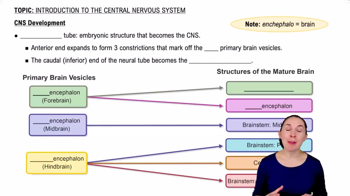
  • Central Nervous System (CNS) components

    Includes the brain and spinal cord; integrates sensory information and coordinates bodily functions.
  • Peripheral Nervous System (PNS) components

    All neural tissue outside CNS, including cranial and spinal nerves, ganglia, and sensory receptors; connects CNS to limbs and organs.
  • Difference between nucleus and ganglion

    Nucleus: cluster of neuron cell bodies in CNS; Ganglion: cluster of neuron cell bodies in PNS.
  • Difference between nerve and tract

    Nerve: bundle of axons in PNS; Tract: bundle of axons in CNS.
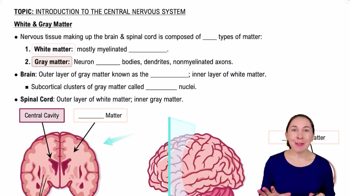
  • Gray matter vs. white matter in CNS

    Gray matter contains neuron cell bodies and unmyelinated axons; white matter contains myelinated axons forming tracts.
  • Major lobes of the cerebrum

    Frontal, parietal, temporal, occipital, and insula lobes.
  • Function of the frontal lobe

    Voluntary movement, planning, reasoning, problem-solving, and speech production (Broca's area).
  • Function of the parietal lobe

    Sensory perception, spatial awareness, and language processing.
  • Function of the temporal lobe

    Auditory processing, memory, and language comprehension (Wernicke's area).
  • Function of the occipital lobe

    Visual processing.
  • Broca's area vs. Wernicke's area

    Broca's area controls speech production; Wernicke's area controls language comprehension.
  • Symptoms of Broca's aphasia

    Difficulty producing speech with intact comprehension.
  • Symptoms of Wernicke's aphasia

    Fluent but nonsensical speech with impaired comprehension.
  • Functions of the thalamus and hypothalamus

    Thalamus relays sensory information; hypothalamus regulates homeostasis, endocrine, and autonomic functions.
  • Role of the cerebellum

    Coordinates voluntary movements, balance, and posture.
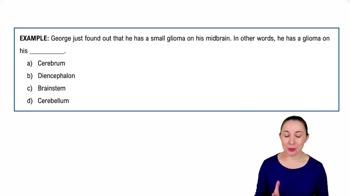
  • Major functions of the brainstem subdivisions

    Midbrain: visual/auditory processing; Pons: relays signals, regulates breathing; Medulla: controls autonomic functions.
  • Spinal cord enlargements and their significance

    Cervical and lumbar enlargements have increased neural input/output for limbs.
  • Components of a reflex arc

    Receptor, sensory neuron, integration center, motor neuron, and effector.
  • Difference between autonomic and somatic reflexes

    Autonomic reflexes involve smooth/cardiac muscle or glands; somatic reflexes involve skeletal muscle.
  • Sympathetic vs. parasympathetic nervous system origins

    Sympathetic: thoracolumbar (T1-L2); Parasympathetic: craniosacral (brainstem and S2-S4).
  • Neurotransmitters of sympathetic and parasympathetic systems

    Sympathetic uses norepinephrine; parasympathetic uses acetylcholine.
  • Function of the blood-brain barrier

    Protects CNS by restricting passage of substances from blood, maintaining a stable environment.
  • Composition and function of cerebrospinal fluid (CSF)

    Clear fluid with water, ions, glucose; cushions CNS, removes waste, and circulates nutrients.
  • Types of sensory receptors

    Thermoreceptors (temperature), photoreceptors (light), chemoreceptors (chemicals), baroreceptors (pressure), nociceptors (pain), mechanoreceptors (touch).
  • Photoreceptors: rods vs. cones

    Rods: peripheral retina, low-light vision, no color; Cones: central retina, color vision, high acuity.
  • Path of light through the eye

    Cornea → aqueous humor → pupil → lens → vitreous humor → retina.
  • Function of the lens in the eye

    Transparent, biconvex structure that focuses light onto the retina.
  • Causes of nearsightedness and farsightedness

    Nearsightedness: image focuses in front of retina; farsightedness: image focuses behind retina.