 Back
Anatomy & Physiology: Nervous System and Sensory Physiology
 04:36

Terms in this set (28)
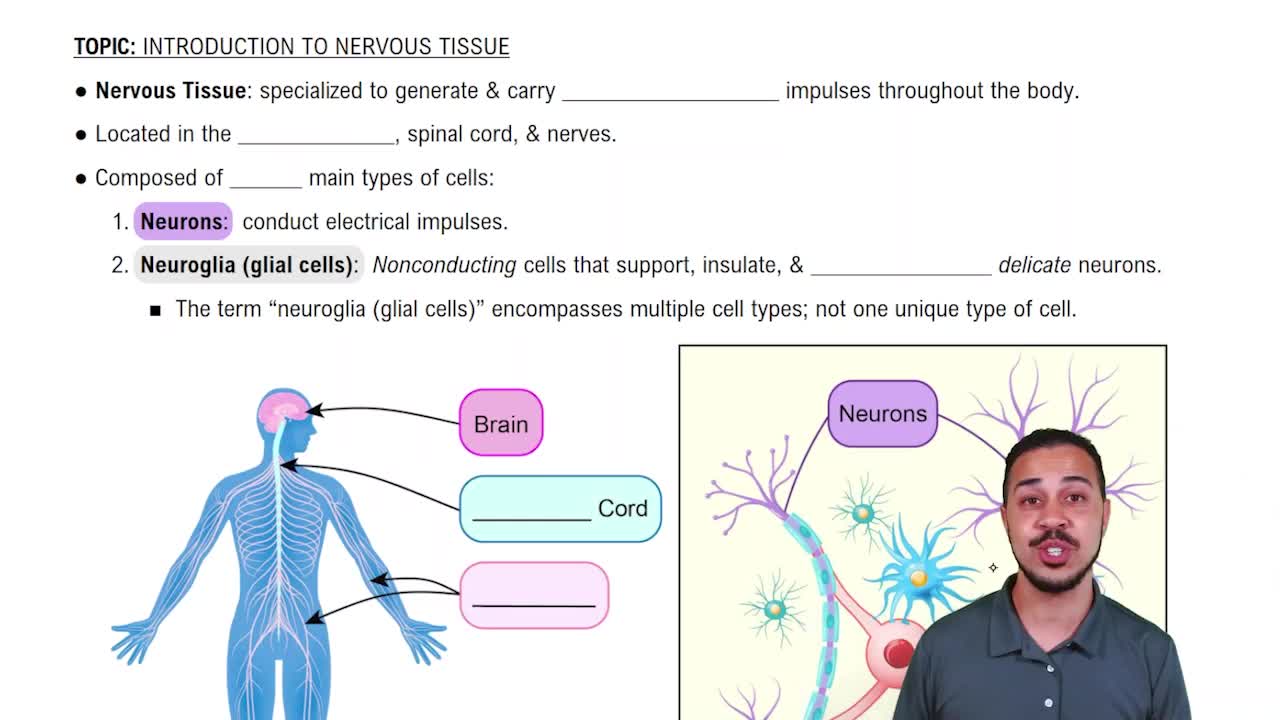
The CNS consists of the brain and spinal cord. It processes, interprets, and stores information, issuing orders to muscles, glands, and organs.
The PNS is composed of nerves outside the CNS. It transmits information to and from the CNS and includes sensory nerves relaying information from the body to the brain.
Controls voluntary movements of skeletal muscles.
Regulates involuntary functions such as glands, blood vessels, and internal organs.
Neurons transmit electrical and chemical signals. Neuroglia support neurons structurally and metabolically, maintaining homeostasis and protection.
Bipolar: one axon, one dendrite (sensory organs). Multipolar: one axon, multiple dendrites (most CNS neurons). Unipolar: single process splitting into two branches (sensory PNS neurons).
Astrocytes: blood-brain barrier, nutrients. Oligodendrocytes: myelin sheath. Microglia: immune defense. Ependymal cells: produce cerebrospinal fluid.
Schwann cells: produce myelin sheath. Satellite cells: support neuron cell bodies in ganglia.
Typically about -70 mV in neurons; the electrical charge difference across the membrane at rest.
Usually around -55 mV; the critical level to initiate an action potential.
Polarization: inside negative. Depolarization: Na+ influx makes inside positive. Repolarization: K+ exits, inside returns negative. Hyperpolarization: inside more negative than resting.
Depolarization: voltage-gated Na+ channels open. Repolarization: Na+ channels close, K+ channels open. Hyperpolarization: K+ channels remain open briefly.
Myelinated: rapid saltatory conduction between nodes of Ranvier. Unmyelinated: slower continuous conduction.
Chemical messenger released by neurons to transmit signals across synapses; produced in the cell body and stored in synaptic vesicles.
Ionotropic: ligand-gated ion channels, fast direct response. Metabotropic: G-protein coupled, slower indirect effects.
Synapse is the junction between neurons where neurotransmitters are released. Ion channels can be passive (always open) or gated (voltage-, ligand-, or mechanically-gated).
Frontal: movement, planning, speech. Parietal: sensory perception. Temporal: auditory, memory. Occipital: visual processing.
Midbrain: visual/auditory reflexes. Pons: relays signals, breathing regulation. Medulla Oblongata: controls heart rate, breathing.
Hippocampus: memory. Amygdala: emotion. Hypothalamus: homeostasis.
White matter: myelinated axons transmitting signals. Gray matter: neuron cell bodies and dendrites processing information.
Stimulus → Receptor → Sensory neuron → Integrating center (spinal cord) → Motor neuron → Effector → Response.
Sympathetic: fight or flight, mobilizes energy. Parasympathetic: rest and digest, conserves energy.
Taste: Facial (VII), Glossopharyngeal (IX), Vagus (X). Smell: Olfactory (I).
Rods: sensitive to low light, night vision. Cones: detect color and sharp vision (S-blue, M-green, L-red cones).
Lens changes shape: rounder for near vision, flatter for distant vision.
Somatic: skin, muscles, joints. Visceral: internal organs. Referred: pain felt away from origin.
Phasic: rapidly adapt (e.g., Pacinian corpuscles). Tonic: slow to adapt (e.g., nociceptors).
Sound waves → outer ear → tympanic membrane → ossicles → cochlear fluid → Organ of Corti → auditory nerve (VIII) → brain (temporal lobe).