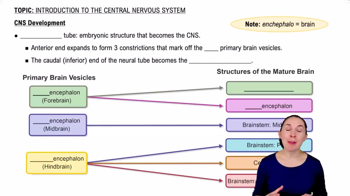
What embryonic structure do the spinal cord and brain develop from?
They develop from the neural tube in the embryo.
Name the three primary brain vesicles and their general contents.
Proencephalon (forebrain), mesencephalon (midbrain), and rhomboencephalon (hindbrain).
What are the meninges from most superficial to deepest?
Dura mater (most superficial), arachnoid mater (middle), and pia mater (deepest).
Where is cerebrospinal fluid (CSF) found?
CSF is found in the choroid plexuses, ventricles, central canal, and surrounding the CNS.
What is the blood-brain barrier and its main function?
A protective barrier formed by tight junctions that maintains a stable brain environment by selectively allowing nutrients and ions.
Name the five lobes of the cerebrum.
Frontal, parietal, occipital, temporal, and insula (deep to other lobes).
What separates the frontal lobe from the parietal lobe?
The central sulcus separates the frontal and parietal lobes.
Define fissures, sulci, and gyri in the cerebrum.
Fissures are deep grooves, sulci are shallow grooves, and gyri are elevated ridges.
Name the ventricles of the brain and which is in the diencephalon.
Two lateral ventricles, third ventricle (in diencephalon), and fourth ventricle.
What is the function of cerebrospinal fluid (CSF)?
CSF cushions the brain, maintains ionic balance, lightens brain weight, and absorbs shock.
What structures make up the brainstem and their functions?
Midbrain (visual and auditory reflexes), pons (relay and respiratory control), medulla oblongata (vital centers for heart rate, respiration, blood pressure).
What is the main function of the frontal lobe?
Contains primary motor cortex, premotor cortex, frontal eye field, Broca's area, and is involved in intelligence and abstract reasoning.
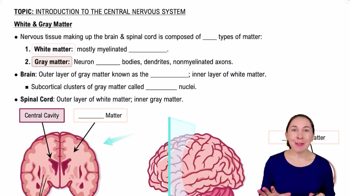
Where is gray matter found in the brain and spinal cord?
In the brain, gray matter is in the cerebral cortex and basal nuclei; in the spinal cord, it forms the central butterfly-shaped area.
What is the function of the thalamus?
Acts as a relay station that sorts, edits, and forwards sensory information to the cerebral cortex.
What are the main functions of the hypothalamus?
Controls blood pressure, heart rate, respiration, pupil size, emotional response, temperature, hunger, thirst, and hormonal activity via the pituitary gland.
What is hemispheric lateralization?
Each cerebral hemisphere specializes in certain tasks, but both work together.
What is decussation and where does it occur?
Crossing over of corticospinal tracts at the medulla oblongata; right brain controls left body and vice versa.
What is the function of the cerebellum?
Subconscious proprioception and coordination of precise timing and patterns of skeletal muscle contractions.
What are basal nuclei and their function?
Groups of CNS cell bodies involved in controlling subconscious motor activity.
What neurotransmitter is released by all preganglionic fibers in the autonomic nervous system?
Acetylcholine, which is excitatory.
What neurotransmitter is released by postganglionic fibers in the sympathetic division?
Epinephrine (adrenaline).
What is dual innervation in the autonomic nervous system?
Both sympathetic and parasympathetic divisions innervate the same organ and have antagonistic effects.
What are the general effects of the sympathetic nervous system?
Dilation of pupils, increased heart rate, blood pressure, respiratory rate, bronchodilation, decreased digestion, and glucose release.
What are the general effects of the parasympathetic nervous system?
Pupil constriction, decreased heart rate, increased digestion, bronchoconstriction, and stimulation of gland secretions.
Where does the sympathetic nervous system exit the CNS?
From the thoracic and lumbar regions of the spinal cord.
Where does the parasympathetic nervous system exit the CNS?
From the cranial and sacral regions.
What are the 12 cranial nerves and their primary functions?
I Olfactory (sensory), II Optic (sensory), III Oculomotor (motor), IV Trochlear (motor), V Trigeminal (mixed), VI Abducens (motor), VII Facial (mixed), VIII Vestibulocochlear (sensory), IX Glossopharyngeal (mixed), X Vagus (mixed), XI Accessory (motor), XII Hypoglossal (motor).
What is the function of the muscle spindle?
A proprioceptor that initiates the stretch reflex by causing contraction of the stretched muscle.
 Back
Back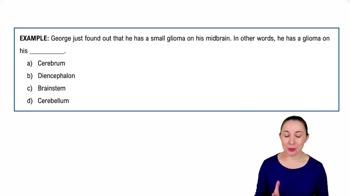
 0:50
0:50