 Back
BackAnatomy & Physiology: Nervous System - Brain and Functions
 0:50
0:50
Terms in this set (20)
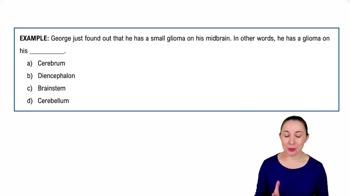
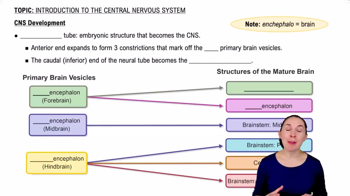
Fore-Brain: 1. Cerebrum, 2. Diencephalon; Mid-Brain; Hind Brain: 4. Pons, 5. Medulla, 6. Cerebellum.
The longitudinal fissure divides the two cerebral hemispheres.
Frontal, Parietal, Temporal, and Occipital lobes.
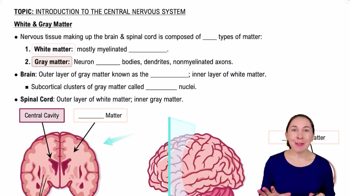
1. Cerebral Cortex (gray matter), 2. Cerebral White Matter (myelinated nerve fibers), 3. Basal Nuclei (cell bodies controlling movements).
It lies in front of the central sulcus and controls voluntary movements of skeletal muscles.
Located just behind the central sulcus, it receives sensory input from the body.
In the visual cortex of the occipital lobe.
It receives taste information and is located on the lateral side of the frontal lobes.
Located in the temporal lobes, it processes sound information.
It receives smell inputs and is located in the temporal lobe near the frontal lobes.
Mid Brain, Pons, and Medulla Oblongata.
Superior colliculi control visual reflexes; inferior colliculi control auditory reflexes.
They are thick bands on the anterior side that connect the brainstem to the cerebrum.
A narrow aqueduct passes through the mid-brain connecting the 3rd and 4th ventricles.
A thick band of nerve fibers anterior to the medulla, connecting cerebellum sides and lower brain parts to the cerebrum; contains the breathing center.
Most inferior brain part, continuous with spinal cord; controls cardiac and breathing centers to regulate heartbeat and breathing rate.
Contains choroid plexus in its posterior wall to secrete cerebrospinal fluid.
The foramen magnum; medulla is superior, spinal cord is inferior to it.
Clusters of cell bodies deep in the cerebral hemispheres that control movement.
General Motor Area, General Sensory Area, Primary Vision, Gustatory, Auditory, and Olfactory Areas.