 Back
BackAnatomy & Physiology: Nervous System Fundamentals
 0:50
0:50
Terms in this set (25)
Cranial cavity contains the brain, a component of the central nervous system.
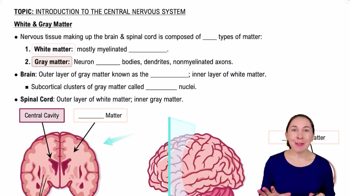
Myelinated axons predominate in the white matter of the brain.
The axon transmits electrical signals to target cells.
A nerve is a bundle of axons in the peripheral nervous system.
The autonomic nervous system controls changes like increased heart rate and sweating during exercise.
Oligodendrocytes provide myelin for axons in CNS tracts.
The soma (cell body) contains the nucleus.
White blood cells are least able to cross the blood-brain barrier.
Microglia are the resident macrophages behind the blood-brain barrier.
Lipids and proteins are the main components of myelin.
Molecules are detected by chemoreceptors.
The cerebral cortex integrates sensory information at the highest level.
Signaling takes a fraction of a second.
The lower motor neuron is the target of an upper motor neuron.
Sodium (Na+) ions enter to depolarize the neuron.
They open at the threshold membrane potential.
Binding of a neurotransmitter is required to open ligand-gated channels.
A physical stimulus opens mechanically gated channels.
Approximately -45 mV is measured during the relative refractory period.
A thick, myelinated axon propagates action potentials fastest.
A change of about +15 mV is necessary for action potential generation.
This causes a hyperpolarizing graded potential.
Acetylcholine is released at the neuromuscular junction.
Metabotropic receptors require an effector protein to initiate signaling.
GABA is associated exclusively with inhibition.