Skip to main content
Anatomy & Physiology
My Course
Learn
Exam Prep
AI Tutor
Study Guides
Textbook Solutions
Flashcards
Explore
Try the app
My Course
Learn
Exam Prep
AI Tutor
Study Guides
Textbook Solutions
Flashcards
Explore
Try the app
Back
Anatomy & Physiology: Nervous System Lab Review
You can tap to flip the card.
Major regions of the brain
You can tap to flip the card.
👆
Major regions of the brain
The brain is divided into the cerebrum, cerebellum, and brainstem, each with distinct structures and functions.
Track progress
Control buttons has been changed to "navigation" mode.
1/21
Recommended videos
0:50
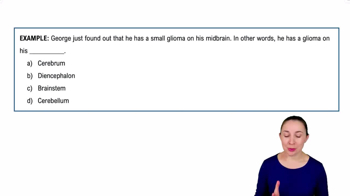
Introduction to the Central Nervous System Example 1
13628
views
253
rank
2
comments
2:41
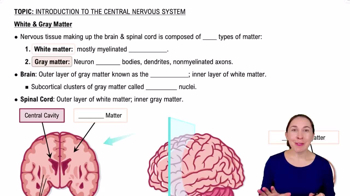
White & Gray Matter
13665
views
248
rank
3:34
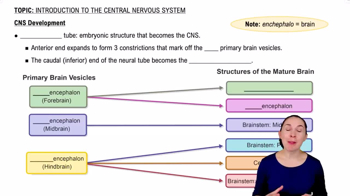
CNS Development
14331
views
289
rank
2
comments
Terms in this set (21)
Hide definitions
Major regions of the brain
The brain is divided into the cerebrum, cerebellum, and brainstem, each with distinct structures and functions.
Function of the cerebrum
The cerebrum controls voluntary movements, sensory perception, reasoning, and memory.
Function of the cerebellum
The cerebellum coordinates balance, posture, and fine motor control.
Function of the brainstem
The brainstem regulates vital functions such as heart rate, breathing, and reflexes.
Major regions of the spinal cord
The spinal cord is divided into cervical, thoracic, lumbar, sacral, and coccygeal regions.
Number of spinal nerve pairs in humans
Humans have 31 pairs of spinal nerves originating from the spinal cord.
Spinal nerve pairs by region
Cervical: 8 pairs, Thoracic: 12 pairs, Lumbar: 5 pairs, Sacral: 5 pairs, Coccygeal: 1 pair.
Cranial nerves: location and function
There are 12 pairs of cranial nerves; each has sensory, motor, or both functions.
Cervical plexus nerves
The cervical plexus is formed by spinal nerves C1 to C4.
Brachial plexus nerves
The brachial plexus is formed by spinal nerves C5 to T1.
Lumbar plexus nerves
The lumbar plexus is formed by spinal nerves L1 to L4.
Sacral plexus nerves
The sacral plexus is formed by spinal nerves L4 to S4.
Types of stimuli detected by sensory receptors
Sensory receptors detect mechanical, thermal, chemical, and pain stimuli.
Mechanoreceptors
Mechanoreceptors respond to mechanical pressure or distortion, such as touch and vibration.
Monosynaptic reflex arc
A reflex arc with a single synapse between sensory and motor neurons, enabling rapid response.
Polysynaptic reflex arc
A reflex arc involving one or more interneurons between sensory and motor neurons, allowing more complex responses.
Divisions of the autonomic nervous system
The autonomic nervous system has sympathetic and parasympathetic divisions with distinct structures and functions.
Sympathetic nervous system structure
Sympathetic neurons have short preganglionic and long postganglionic fibers.
Parasympathetic nervous system structure
Parasympathetic neurons have long preganglionic and short postganglionic fibers.
Main effects of the sympathetic nervous system
Increases heart rate, dilates pupils, inhibits digestion, and prepares body for 'fight or flight.'
Main effects of the parasympathetic nervous system
Decreases heart rate, constricts pupils, stimulates digestion, and promotes 'rest and digest.'
 BackBack
 0:50