 Back
Anatomy & Physiology: Nervous System Overview
 0:50

Terms in this set (20)
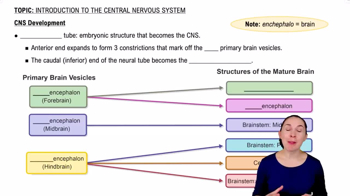
The telencephalon, diencephalon, mesencephalon, metencephalon, and myelencephalon.
Includes the cerebral cortex responsible for higher brain functions like speech, understanding, and voluntary movement.
Contains the thalamus and hypothalamus, involved in sensory relay and autonomic control.
Also called the midbrain, it controls visual and auditory reflexes and motor coordination.
Includes the pons and cerebellum, important for motor control and balance.
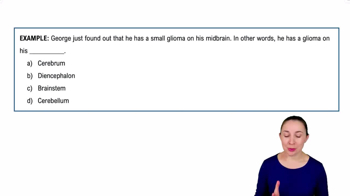
Contains the medulla oblongata, which regulates vital autonomic functions like breathing and heart rate.
Frontal: motor control and decision making; Parietal: sensory processing; Temporal: hearing and memory; Occipital: vision; Insular: visceral sensation.
Primarily in the left hemisphere of the frontal and temporal lobes, including Broca's and Wernicke's areas.
Dura mater, arachnoid mater, and pia mater.
Four ventricles: two lateral, third, and fourth. CSF flows from lateral ventricles → third ventricle → cerebral aqueduct → fourth ventricle → subarachnoid space.
Spinothalamic tract (pain and temperature) and dorsal column-medial lemniscal pathway (touch and proprioception).
Corticospinal tract (voluntary motor control) and vestibulospinal tract (balance and posture).
Include mechanoreceptors, thermoreceptors, nociceptors, photoreceptors, and chemoreceptors.
12 pairs, responsible for sensory and motor functions of the head and neck.
To provide a rapid, involuntary response to stimuli to protect the body or maintain homeostasis.
Receptor, sensory neuron, integration center (usually interneuron), motor neuron, and effector.
Prepares the body for fight or flight responses: increases heart rate, dilates pupils, inhibits digestion.
Promotes rest and digest activities: slows heart rate, stimulates digestion, conserves energy.
Sympathetic neurons originate in the thoracolumbar spinal cord; parasympathetic neurons originate in the craniosacral regions.
Sympathetic uses norepinephrine on adrenergic receptors; parasympathetic uses acetylcholine on muscarinic receptors.