 Back
BackAnatomy & Physiology: Nervous System Sensory and Motor Pathways
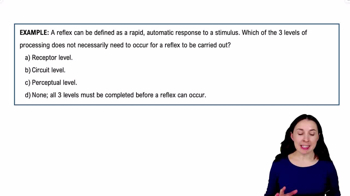
 1:34
1:34
Terms in this set (29)
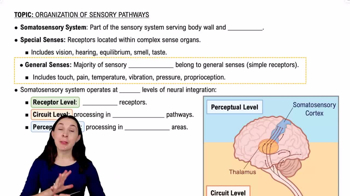
Includes receptors, sensory neurons, and sensory pathways that detect and transmit sensory information.
Composed of nuclei, motor tracts, and motor neurons that control muscle and gland responses.
Stimulus → receptor → action potential → CNS → response
Only about 1% of sensory information reaches conscious awareness.
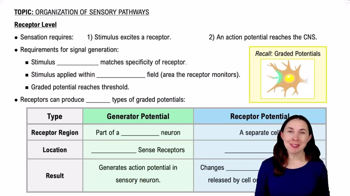
Conversion of a stimulus into an electrical signal (action potential).
Process where a small stimulus produces a large electrical signal.
Each receptor responds to a specific type of stimulus.
By increasing the frequency of action potentials, activating more receptors, and longer duration of action potentials.
The brain identifies a stimulus based on the pathway it travels.
Sensation is incoming sensory information; perception is the conscious awareness of that sensation.
Senses like touch, pain, temperature, pressure, vibration, and proprioception.
Senses including smell, vision, taste, hearing, and balance.
The area monitored by a single sensory receptor.
Large receptive fields result in less precise sensory localization.
A graded change in membrane potential of a receptor cell in response to stimulus strength.
A decreased response to a constant stimulus over time.
The CNS ignores a continuous sensory signal.
The receptor stops responding to a constant stimulus.
Receptors that are always active and adapt slowly.
Pain receptors are tonic receptors.
Receptors that respond quickly and adapt fast by turning on/off.
Temperature receptors are phasic receptors.
Detect stimuli from the external environment.
Detect stimuli from internal organs.
Detect body position and movement.
Detect pain stimuli.
Detect temperature changes.
Detect physical distortion like stretch, pressure, and vibration.
Detect chemical changes such as pH, CO2, and O2 levels.