 Back
Anatomy & Physiology: Nucleic Acids and Lipids
 01:05

Terms in this set (22)
Nucleic acids are large molecules like DNA and RNA that store and encode genetic information required to build proteins.
The monomers of nucleic acids are nucleotides, each consisting of a phosphate group, a pentose sugar, and a nitrogenous base.
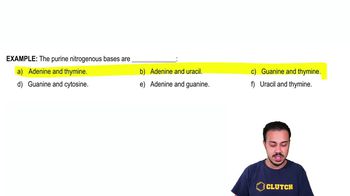
DNA has adenine (A), thymine (T), cytosine (C), and guanine (G). RNA has adenine (A), uracil (U) instead of thymine, cytosine (C), and guanine (G).
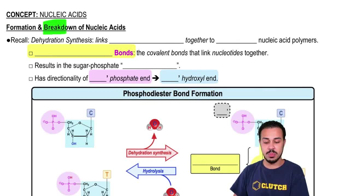
Nucleotides are linked by dehydration synthesis forming a sugar-phosphate backbone with nitrogenous bases sticking out.
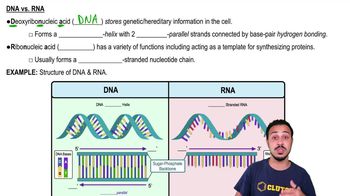
DNA is a double-stranded polymer with complementary base pairing: A pairs with T, and C pairs with G, held together by hydrogen bonds forming a double helix.
RNA is a single-stranded polymer that carries genetic information from DNA to the cytoplasm and helps in protein synthesis (mRNA, tRNA, rRNA).
DNA replication copies DNA strands to make new DNA, while transcription copies DNA into RNA using RNA nucleotides (U replaces T).
Carbohydrates, proteins, nucleic acids, and lipids.
A polymer is a large molecule made of repeating subunits called monomers, e.g., proteins are polymers of amino acid monomers.
A chemical reaction that joins monomers by removing a water molecule to form a covalent bond.
A reaction that breaks polymers into monomers by adding a water molecule.
Because carbon and hydrogen share electrons equally, forming nonpolar covalent bonds, hydrocarbons do not interact with water and are hydrophobic.
Lipids are not polymers; they are mostly carbon and hydrogen linked by nonpolar bonds and are hydrophobic molecules.
Fats (triglycerides), phospholipids, and steroids.
A triglyceride consists of three fatty acids attached to one glycerol molecule.
Saturated fatty acids have no double bonds and are straight, allowing tight packing; unsaturated fatty acids have one or more double bonds causing bends and looser packing.
Saturated fats are usually solid at room temperature; unsaturated fats are usually liquid due to bent fatty acid chains.
Phospholipids have two fatty acid tails (hydrophobic) and a phosphate head (hydrophilic), making them amphipathic and essential for forming cell membranes.
A molecule with both hydrophilic (water-loving) and hydrophobic (water-fearing) regions.
Steroids have a structure of four fused carbon rings and are derived from cholesterol.
Testosterone, estradiol (a form of estrogen), and cortisol are steroid hormones derived from cholesterol.
Fat stores about twice as much energy per kilogram as glycogen, so storing energy as glycogen requires more mass.