 Back
BackAnatomy & Physiology: Reproductive and Breast Anatomy
 1:07
1:07
Terms in this set (28)
The circular, darker-pigmented skin surrounding the nipple. Contains specialized glands and muscles that support breastfeeding and protect the nipple.
The central raised structure on the breast where milk exits during breastfeeding. It is the small, projecting part in the middle of the areola.
A modified sweat gland located within the breast responsible for milk production during lactation.
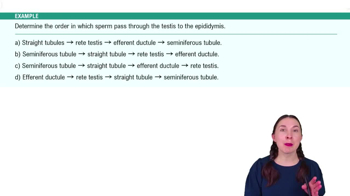
A thick-walled muscular tube that transports sperm from the epididymis to the ejaculatory duct, propelling sperm during ejaculation.
Paired male reproductive organs in the scrotum responsible for sperm production in seminiferous tubules and testosterone secretion from Leydig cells.
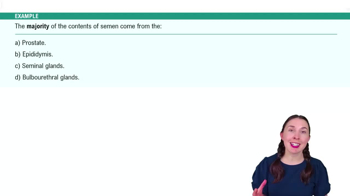
A male reproductive gland located below the bladder and surrounding the proximal urethra, contributing to seminal fluid.
The external male reproductive organ involved in urination and sexual reproduction.
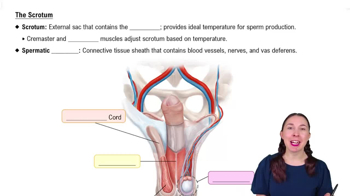
A sac of skin and smooth muscle holding the testicles outside the body; contains dartos muscle (wrinkles skin) and cremaster muscle (lifts testes).
A large, fan-shaped muscle on the anterior chest wall forming the bulk of the chest, lying deep to breast tissue.
A hollow, muscular organ that supports implantation, fetal development, and labor.
The inner lining of the uterus that thickens monthly and sheds during menstruation.
The thick smooth muscle layer of the uterus responsible for contractions during labor.
The outer serous covering of the uterus.
The lower, narrow portion of the uterus that opens into the vagina.
A muscular canal that receives the penis, serves as the birth canal, and allows menstrual flow.
Produces oocytes and secretes estrogen and progesterone.
Transports the oocyte from the ovary to the uterus and is the site of fertilization.
The widest part of the uterine tube and the most common site of fertilization.
Fingerlike projections that sweep the oocyte into the uterine tube.
Estrogen: drives breast development at puberty.
Progesterone: stimulates growth of alveoli and lobules.
Prolactin: primary hormone for milk production.
Oxytocin: causes milk ejection triggered by nipple stimulation.
Formed from the ruptured follicle after ovulation; secretes progesterone and estrogen to maintain the endometrium; degenerates if no fertilization occurs.
Primordial follicle → Primary follicle → Secondary follicle → Vesicular (Graafian) follicle → Ovulation → Corpus luteum.
Small, resting follicle formed before birth containing a primary oocyte arrested in prophase I.
Large fluid-filled follicle with oocyte surrounded by cumulus oophorus and corona radiata; oocyte completes meiosis I to become secondary oocyte.
A temporary organ formed from fetal (chorion) and maternal (endometrium) tissues that facilitates exchange of oxygen, nutrients, and waste between mother and fetus.
A flexible, ropelike structure connecting the fetus to the placenta.
A fetal blood vessel connecting the pulmonary trunk to the descending aorta, bypassing the fetal lungs; becomes ligamentum arteriosum after birth.
A flaplike opening between the right and left atria in the fetal heart that bypasses the pulmonary circuit; becomes fossa ovalis after birth.