Skip to main content
Anatomy & Physiology
My Course
Learn
Exam Prep
AI Tutor
Study Guides
Textbook Solutions
Flashcards
Explore
Try the app
My Course
Learn
Exam Prep
AI Tutor
Study Guides
Textbook Solutions
Flashcards
Explore
Try the app
Back
Anatomy & Physiology: Respiratory, Blood, Heart, and Vessels Overview
You can tap to flip the card.
Major function of the respiratory system
You can tap to flip the card.
👆
Major function of the respiratory system
To facilitate gas exchange, supplying oxygen to the blood and removing carbon dioxide.
Track progress
Control buttons has been changed to "navigation" mode.
1/43
Recommended videos
4:28
Ventilation
7809
views
187
rank
1
comments
5:55
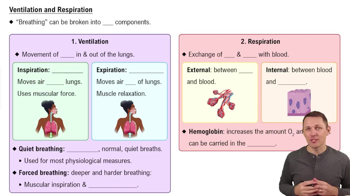
Ventilation and Respiration
11594
views
348
rank
1
comments
1:37
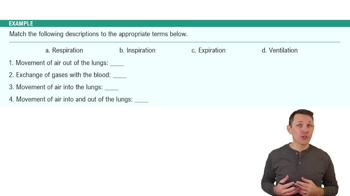
Introduction to Lung Physiology Example 1
7851
views
212
rank
1
comments
Terms in this set (43)
Hide definitions
Major function of the respiratory system
To facilitate gas exchange, supplying oxygen to the blood and removing carbon dioxide.
Four processes involved with respiration
Pulmonary ventilation
,
external respiration
,
internal respiration
, and
transport of gases
.
General functions of upper respiratory organs
Filter, warm, and humidify air; includes nose, pharynx, and larynx.
General functions of lower respiratory organs
Conduct air to lungs and facilitate gas exchange; includes trachea, bronchial tree, and lungs.
Composition of bronchial tree branches
Bronchioles have
smooth muscle
and
cuboidal epithelial cells
.
Difference between conducting and respiratory zones
Conducting zone moves air; respiratory zone contains alveoli where gas exchange occurs.
Significant features of alveoli
Thin walls, large surface area, surrounded by capillaries for efficient gas exchange.
Function of pleurae
Membranes that reduce friction and create pressure gradients for lung expansion.
Pulmonary ventilation stages
Inhalation and exhalation involving volume changes that alter pressure to move air.
Gas law applying to pulmonary ventilation
Boyle's law
: pressure inversely varies with volume.
Effect of volume change on pressure in lungs
Increasing lung volume decreases pressure, causing air to flow in; decreasing volume increases pressure, pushing air out.
Dalton's law in respiration
Total pressure is the sum of partial pressures of individual gases.
Henry's law in respiration
Gas solubility in liquid is proportional to its partial pressure.
External respiration influences
Partial pressure gradients, gas solubility, membrane thickness, and surface area affect gas exchange.
Internal respiration influence
Driven by partial pressure gradients between blood and tissues.
Oxygen transport in blood
Mostly bound to hemoglobin in erythrocytes; some dissolved in plasma.
Partial pressure of oxygen locations
High in lungs/alveoli; low in tissues.
Types of hypoxia
Hypoxic, anemic, ischemic, and histotoxic hypoxia.
Factors changing oxygen-hemoglobin affinity
pH, temperature, CO2 levels, and 2,3-BPG concentration.
Carbon dioxide transport methods
Dissolved in plasma, bound to hemoglobin, and as bicarbonate ions.
Partial pressure of carbon dioxide locations
High in tissues; low in lungs.
General functions of blood
Transport, regulation, and protection.
Components of blood
Plasma
and
formed elements
(erythrocytes, leukocytes, platelets).
Function of erythrocytes
Transport oxygen and carbon dioxide.
Regulation of erythrocyte count
Controlled by erythropoietin hormone based on oxygen levels.
General functions of leukocytes
Immune defense and inflammation.
Phases of hemostasis
Vascular spasm, platelet plug formation, and coagulation.
Agglutinogens and agglutinins
Agglutinogens are blood group antigens; agglutinins are antibodies against them.
Rh factor and pregnancy
Rh-negative mothers can develop antibodies against Rh-positive fetus, causing hemolytic disease.
Pulmonary vs systemic circuits
Pulmonary circuit carries blood to lungs; systemic circuit carries blood to body tissues.
Heart structure basics
Includes coverings, four chambers, and valves.
Pathway of blood through the heart
Right atrium → right ventricle → lungs → left atrium → left ventricle → body.
Characteristics of cardiac muscle fibers
Striated, branched, interconnected, with abundant mitochondria.
Sequence of cardiac excitation
SA node → AV node → AV bundle → bundle branches → Purkinje fibers.
Phases of cardiac cycle
Atrial systole, ventricular systole, and relaxation.
Tunics of blood vessels
Tunica intima, tunica media, and tunica externa.
Characteristics of arteries
Elastic, muscular, and arterioles with thick walls and high pressure.
Characteristics of capillaries
Continuous, fenestrated, and sinusoidal types with varying permeability.
Mechanism of exchange in capillaries
Diffusion, filtration, and osmosis influenced by hydrostatic and osmotic pressures.
Characteristics of veins
Thinner walls, larger lumen, valves to prevent backflow.
Definition of pulse
Rhythmic expansion of an artery due to heartbeats.
Meaning of blood pressure numbers
Systolic pressure over diastolic pressure, indicating heart contraction and relaxation.
Factors influencing blood pressure
Cardiac output, blood volume, resistance, and vessel elasticity.
 BackBack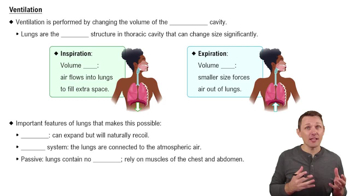
 4:28
4:28