Skip to main content
Anatomy & Physiology
My Course
Learn
Exam Prep
AI Tutor
Study Guides
Textbook Solutions
Flashcards
Explore
Try the app
My Course
Learn
Exam Prep
AI Tutor
Study Guides
Textbook Solutions
Flashcards
Explore
Try the app
Back
Anatomy & Physiology: Skeletal Muscle Structure and Function
You can tap to flip the card.
Skeletal muscle fiber
You can tap to flip the card.
👆
Skeletal muscle fiber
Specialized long, thin, multinucleated cells that compose skeletal muscles.
Track progress
Control buttons has been changed to "navigation" mode.
1/31
Recommended videos
Guided course
6:31
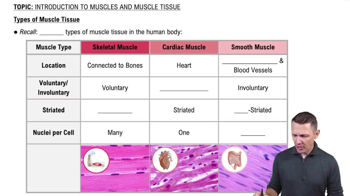
Types of Muscle Tissue
18700
views
494
rank
1
comments
Guided course
2:00
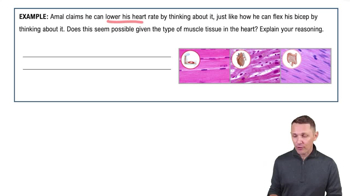
Introduction to Muscles and Muscle Tissue Example 1
16627
views
323
rank
Guided course
4:36
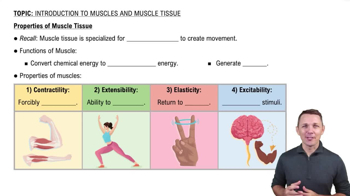
Properties of Muscle Tissue
25590
views
741
rank
2
comments
Terms in this set (31)
Hide definitions
Skeletal muscle fiber
Specialized long, thin, multinucleated cells that compose skeletal muscles.
Endomysium
Thin layer of extracellular matrix surrounding each muscle fiber.
Fascicle
Bundle of 10–100 muscle fibers surrounded by perimysium.
Epimysium
Connective tissue sheath surrounding all fascicles in a muscle.
Fascia
Most superficial connective tissue sheath, continuous with epimysium.
Tendon
Connective tissue attaching muscle to bone, transmitting force for movement.
Parallel fascicle pattern
Fascicles run parallel to the muscle’s length, e.g., Sartorius.
Pennate fascicle pattern
Fascicles attach to tendon at an angle, resembling a feather; includes unipennate, bipennate, multipennate.
Agonist (Prime Mover)
Main muscle responsible for producing a specific movement.
Antagonist muscle
Muscle that opposes the action of the agonist, allowing controlled movement.
Synergist muscle
Assists the agonist by stabilizing and guiding movement.
Fixator muscle
Stabilizes the origin of the agonist to increase movement efficiency.
Muscle origin
Fixed attachment point of a muscle, usually proximal.
Muscle insertion
Moveable attachment point of a muscle; moves toward origin during contraction.
First-class lever in the body
Fulcrum is between load and force, e.g., atlanto-occipital joint.
Second-class lever in the body
Load is between fulcrum and force, e.g., metatarsophalangeal joints.
Third-class lever in the body
Force is between fulcrum and load, e.g., elbow joint.
Mechanical advantage
Small force moves a large load when fulcrum is close to load.
Muscle naming by size
Terms like brevis (short), longus (long), vastus (large) describe muscle size.
Muscle naming by function
Names like flexor, extensor, adductor describe muscle action.
Epicranius muscle action
Elevates eyebrows and forehead.
Orbicularis oculi action
Closes the eyelids.
Masseter muscle action
Elevates the mandible for chewing.
Diaphragm muscle function
Contracts to increase thoracic volume during inspiration.
Rectus abdominis action
Flexes the trunk and forms the 'six-pack'.
Levator ani muscle function
Supports the pelvic floor.
Serratus anterior action
Protracts and rotates the scapula.
Deltoid muscle action
Abducts, flexes, and extends the arm at the shoulder.
Biceps brachii action
Flexes and supinates the forearm.
Triceps brachii action
Extends the forearm at the elbow.
Tibialis anterior action
Dorsiflexes and inverts the foot.
 BackBack
 6:31