 Back
BackAnatomy & Physiology: Skeletal, Muscular, and Nervous Systems
 4:50
4:50
Terms in this set (20)
Compact bone is dense and forms the outer layer of bones, providing strength. Spongy bone is porous and found inside bones, containing marrow and reducing bone weight.
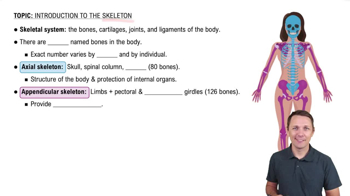
The axial skeleton includes the skull, vertebral column, and rib cage, supporting the central axis of the body.
The appendicular skeleton consists of the limbs and girdles (shoulder and pelvic), enabling movement.
The CNS processes sensory information, controls motor functions, and integrates data to coordinate body activities.
Muscle contraction involves excitation, excitation-contraction coupling, and contraction phases.
Excitation is the process where a nerve impulse triggers the release of neurotransmitters to stimulate a muscle fiber.
This phase links the muscle fiber excitation to contraction by releasing calcium ions that enable actin-myosin interaction.
During contraction, actin and myosin filaments slide past each other, shortening the muscle fiber and generating force.
The PNS includes all nerves outside the CNS, transmitting signals between the CNS and the rest of the body.
Nerves in the PNS carry sensory information to the CNS and motor commands from the CNS to muscles and glands.
Muscles studied include those in the head and neck, trunk, upper limb, and lower limb.
Key brain parts covered include those visible in the sheep brain dissection, excluding the cow eye.
Origins are fixed attachment points; insertions are movable attachment points. Origins and insertions were not required to be memorized.
Calcium ions bind to troponin, causing tropomyosin to move and expose binding sites for myosin on actin filaments.
Explored parts include the axial and appendicular skeleton, excluding human cadaver and histology sections.
Explored parts include muscles of the head and neck, trunk, upper limb, and lower limb, excluding cadaver and histology.
Explored parts include the sheep brain dissection images and labels; cow eye information is excluded.
The vertebral column supports the body, protects the spinal cord, and allows flexible movement.
Neurotransmitters like acetylcholine transmit nerve impulses across the neuromuscular junction to initiate muscle excitation.
The axial skeleton supports and protects vital organs; the appendicular skeleton facilitates movement.