Skip to main content
Anatomy & Physiology
My Course
Learn
Exam Prep
AI Tutor
Study Guides
Textbook Solutions
Flashcards
Explore
Try the app
My Course
Learn
Exam Prep
AI Tutor
Study Guides
Textbook Solutions
Flashcards
Explore
Try the app
Back
Anatomy & Physiology: Skeletal System and Vertebral Column
You can tap to flip the card.
What are the two main divisions of the skeleton?
You can tap to flip the card.
👆
What are the two main divisions of the skeleton?
Axial skeleton
(midline bones including skull, vertebral column, thoracic cage) and
appendicular skeleton
(limbs and girdles).
Track progress
Control buttons has been changed to "navigation" mode.
1/20
Recommended videos
Guided course
2:12
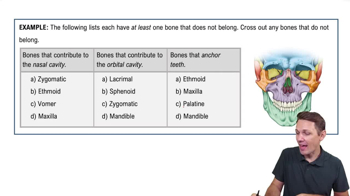
The Skull Example 1
9881
views
226
rank
Guided course
4:42
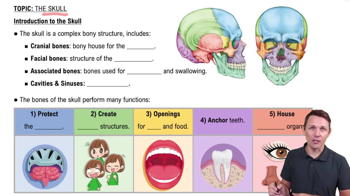
Introduction to the Skull
18069
views
413
rank
Guided course
3:40
The Skull Example 3
7173
views
138
rank
Terms in this set (20)
Hide definitions
What are the two main divisions of the skeleton?
Axial skeleton
(midline bones including skull, vertebral column, thoracic cage) and
appendicular skeleton
(limbs and girdles).
How many bones are in the adult human skeleton?
There are
206 bones
in the adult human skeleton.
What causes the decrease in bone number from birth to adulthood?
Decrease is due to
fusion of bones
, such as the mandible, frontal bone, os coxae, and sacrum.
Define the bone surface feature: facet.
A
facet
is a smooth articular surface on a bone.
What is a tuberosity on a bone?
A
tuberosity
is a rough surface on a bone that serves as a muscle attachment site.
What is a foramen in bone anatomy?
A
foramen
is a hole in a bone that allows passage of nerves or blood vessels.
What are fontanelles in the infant skull?
Fontanelles are
soft spots
or spaces between unfused cranial bones in infants.
Name the four fontanelles of the infant skull.
Anterior, posterior, sphenoidal, and mastoid fontanelles.
What are sutures in the skull?
Sutures are
immovable joints
that connect cranial bones.
List the four major paranasal sinuses.
Frontal, sphenoidal, ethmoid, and maxillary sinuses.
What is the function of paranasal sinuses?
They
lighten the skull
and act as
resonance chambers
for voice.
How many cervical vertebrae are there and what mnemonic helps remember this?
There are
7 cervical vertebrae
. Remember: Breakfast at 7 a.m.
How many thoracic vertebrae are there and what mnemonic helps remember this?
There are
12 thoracic vertebrae
. Remember: Lunch at 12 p.m.
How many lumbar vertebrae are there and what mnemonic helps remember this?
There are
5 lumbar vertebrae
. Remember: Dinner at 5 p.m.
What is the vertebral foramen?
The
vertebral foramen
is the passage through which the spinal cord travels.
What is the function of intervertebral discs?
They act as
pads of fibrocartilage
between vertebrae, providing cushioning and flexibility.
What is a herniated disc?
A
herniated disc
is a rupture or slip of the intervertebral disc, often causing nerve pain.
What is the atlas (C1) vertebra specialized for?
The atlas supports the skull and allows the nodding motion of the head.
What is the axis (C2) vertebra specialized for?
The axis has the
dens (odontoid process)
which allows rotation of the head.
What is the function of the transverse foramen in cervical vertebrae?
It allows passage of blood vessels to and from the brain.
 BackBack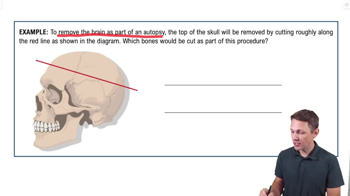
 2:12
2:12