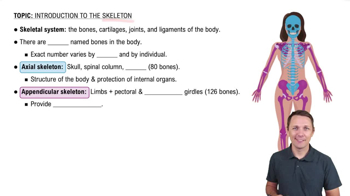
The skeleton is divided into the axial skeleton (skull, vertebral column, rib cage) and the appendicular skeleton (limbs and girdles).
Functions of the skeletal system
The skeletal system provides support, protection, movement, mineral storage, blood cell production, and energy storage.
Four main classifications of bones
Bones are classified as long, short, flat, and irregular based on their shape.
Major anatomical areas of a long bone
A long bone includes the diaphysis (shaft), epiphyses (ends), metaphysis (growth region), and medullary cavity (marrow space).
Microscopic structure of compact bone
Compact bone is made of osteons or Haversian systems, which contain concentric lamellae around a central canal with blood vessels.
Role of bone salts and organic matrix
Bone salts (calcium phosphate) provide hardness, while the organic matrix (collagen fibers) provides flexibility and tensile strength.
Bone formation in the fetus
Bone forms by intramembranous and endochondral ossification, starting as cartilage or membrane and gradually replaced by bone.
Bone remodeling throughout life
Bone is continuously remodeled by osteoclasts (resorption) and osteoblasts (formation) to maintain strength and mineral balance.
Types of bone fractures
Common fractures include simple, compound, greenstick, comminuted, and spiral fractures.
Bones of the skull and major sutures
The skull includes the frontal, parietal, temporal, occipital, sphenoid, and ethmoid bones; major sutures are coronal, sagittal, lambdoid, and squamous.
Parts of a typical vertebra
A vertebra has a body, vertebral arch, spinous process, transverse processes, and vertebral foramen.
Differences among cervical, thoracic, and lumbar vertebrae
Cervical vertebrae are small with transverse foramina; thoracic have facets for ribs; lumbar are large and robust for weight bearing.
Importance of intervertebral discs and spinal curvatures
Intervertebral discs cushion vertebrae; spinal curvatures (cervical, thoracic, lumbar, sacral) provide balance and shock absorption.
Abnormal spinal curvatures
Scoliosis is lateral curvature, lordosis is excessive inward lumbar curve, and kyphosis is excessive outward thoracic curve.
Components of the thoracic cage
The thoracic cage consists of the thoracic vertebrae, ribs, and sternum.
Difference between true ribs and false ribs
True ribs attach directly to the sternum; false ribs attach indirectly or not at all (floating ribs).
Bones of the shoulder and pelvic girdles
The shoulder girdle includes the clavicle and scapula; the pelvic girdle includes the ilium, ischium, and pubis.
Differences between male and female pelvis
Female pelvis is wider, shallower, with a larger pelvic inlet and outlet for childbirth; male pelvis is narrower and taller.
Three major structural categories of joints
Fibrous (immovable), cartilaginous (slightly movable), and synovial (freely movable) joints.
Skeletal development changes from fetus to adult
Skeleton changes from mostly cartilage in fetus to ossified bone in adults, with growth plates active during youth.
Causes of bone and joint problems
Problems can arise from injury, infection, arthritis, osteoporosis, and nutritional deficiencies.
Differences in newborn skull and function of fontanels
Newborn skull bones are not fused; fontanels are soft spots allowing brain growth and easier passage through birth canal.
 Back
 4:50
