What are the main components of the skeletal system?
The skeletal system consists of the skull, vertebral column, thoracic cage, pectoral girdle, upper limb, pelvic girdle, lower limb, and skeletal cartilages.
What bones make up the axial skeleton?
The axial skeleton includes the bones of the skull, vertebral column, and thoracic cage.
What bones make up the appendicular skeleton?
The appendicular skeleton consists of the bones of the pectoral girdle, upper limb, pelvic girdle, and lower limb.
What are the three basic types of bone markings?
The three basic types of bone markings are depressions, openings, and projections.
What bones form the cranium?
The cranium is formed by eight bones: frontal, two parietal, two temporal, occipital, sphenoid, and ethmoid bones.
Which bones are included in the facial skeleton?
Facial bones include the mandible, vomer, maxillary, zygomatic, nasal, lacrimal, palatine, and inferior nasal conchal bones.
How are most skull bones joined together?
All skull bones except the mandible are joined by immoveable sutures.
Which bones contribute to the formation of the orbit?
The orbit is formed by the frontal, maxillary, zygomatic, sphenoid, ethmoid, lacrimal, and palatine bones.
Which bones form the nasal cavity?
The nasal cavity is formed by the ethmoid, vomer, nasal, palatine, sphenoid, and maxillary bones.
What are paranasal sinuses and their function?
Paranasal sinuses are air-filled cavities in the frontal, maxillary, sphenoid, and ethmoid bones that warm, filter, and humidify inspired air.
Which bones form the oral cavity?
The oral cavity is formed by the maxillary, palatine, and mandibular bones.
How does the fetal skull develop and what feature does this cause?
The fetal skull forms largely by intramembranous ossification, resulting in the presence of fontanels.
What is unique about the hyoid bone?
The hyoid bone is suspended in the neck by muscles and does not articulate directly with other bones.
How many vertebrae are in the vertebral column and their regions?
The vertebral column has cervical, thoracic, lumbar, fused sacral, and fused coccygeal vertebrae.
What are the four normal spinal curvatures?
The spinal curvatures are concave cervical and lumbar, and convex thoracic and sacral curvatures.
What common features do vertebrae share?
Vertebrae have a central body, vertebral foramen, lateral transverse processes, and a posterior spinous process.
What distinguishes cervical vertebrae from others?
Cervical vertebrae have transverse foramina in their transverse processes; the atlas is C1 and the axis is C2.
What features characterize thoracic vertebrae?
Thoracic vertebrae have superior and inferior costal facets for rib articulation.
Which vertebrae are the thickest and heaviest?
Lumbar vertebrae are the thickest and heaviest vertebrae.
What is the function of sacral foramina?
Sacral foramina in the fused sacral vertebrae allow passage of nerves.
What is an intervertebral disc?
An intervertebral disc is a fibrocartilage pad located between two vertebrae.
What bones make up the thoracic cage?
The thoracic cage consists of the sternum, 12 pairs of ribs, and thoracic vertebrae.
What bones form the pectoral girdle?
The pectoral girdle consists of the clavicle and scapula.
Where does the clavicle articulate?
The clavicle articulates medially with the manubrium of the sternum and laterally with the acromion of the scapula.
What are notable features of the scapula?
The scapula rests on the posterosuperior rib cage and features the posterior acromion and lateral glenoid cavity.
What is the only bone of the arm and its articulations?
The humerus is the only arm bone; proximally it articulates with the glenoid cavity, distally with the radius and ulna.
What bones make up the forearm?
The forearm consists of the medial ulna and lateral radius.
How many carpals, metacarpals, and phalanges are in the wrist and hand?
The wrist has 8 carpals, the hand has 5 metacarpals, and the fingers have 14 phalanges.
What bones form the pelvic girdle?
The pelvic girdle consists of two pelvic bones, each with ilium, ischium, and pubis, articulating posteriorly with the sacrum.
What is the only bone of the thigh and its articulations?
The femur is the only thigh bone; proximally it articulates with the acetabulum, distally with the tibia at the condyles.
What is the patella and where is it located?
The patella is a sesamoid bone within the tendon of the quadriceps femoris muscle group.
Which bones form the leg?
The tibia is the medial leg bone, and the fibula is the lateral leg bone.
What bones compose the foot and ankle?
The foot and ankle are composed of tarsals, metatarsals, and phalanges.
What are the three arches of the foot?
The foot has three arches: medial and lateral longitudinal arches, and the transverse arch.
 Back
Back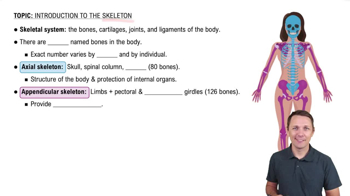
 4:50
4:50