 Back
Anatomy & Physiology: Skeletal System Overview
 4:50

Terms in this set (20)
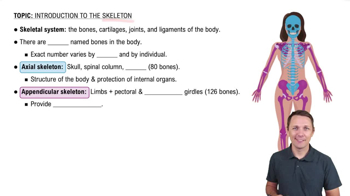
The axial skeleton includes the skull, vertebral column, and thoracic cage. The appendicular skeleton includes the pectoral girdle, upper limbs, pelvic girdle, and lower limbs.
Bone markings serve as sites for muscle attachment, joint formation, and passageways for nerves and blood vessels.
The skeletal system contains hyaline cartilage, fibrocartilage, and elastic cartilage.
Cranial bones protect the brain, provide attachment sites for head and neck muscles, and form the structure of the skull.
Sutures are immovable joints that unite the cranial bones, such as the coronal, sagittal, lambdoid, and squamous sutures.
Facial bones support the eyes, provide attachment for facial muscles, and form the nasal cavity and oral cavity.
The hyoid bone does not articulate with any other bone and supports the tongue and neck muscles.
The orbit is a bony cavity formed by several facial and cranial bones that houses and protects the eye.
They warm, moisten, and filter air; the sinuses also lighten the skull and enhance voice resonance.
The fetal skull has fontanelles (soft spots) and more flexible sutures to allow brain growth and passage through the birth canal.
The vertebral column has four curvatures: cervical and lumbar (concave posteriorly), thoracic and sacral (convex posteriorly).
Cervical vertebrae are small with transverse foramina; thoracic vertebrae have facets for ribs; lumbar vertebrae are large and support weight.
The sacrum is a fused set of vertebrae forming the back of the pelvis; the coccyx is the tailbone, formed by fused vertebrae.
Intervertebral discs are fibrocartilage pads that absorb shock and allow flexibility between vertebrae.
The thoracic cage includes the sternum, ribs, and thoracic vertebrae; it protects the heart and lungs and supports respiration.
The pectoral girdle consists of the clavicle and scapula, which attach the upper limbs to the axial skeleton.
The upper limb includes the humerus, radius, ulna, carpals, metacarpals, and phalanges.
The pelvic girdle is formed by two hip bones (each made of ilium, ischium, and pubis) that attach the lower limbs to the axial skeleton.
Female pelvis is wider, shallower, and has a larger pelvic inlet for childbirth; male pelvis is narrower and taller.
The thigh has the femur; the leg has the tibia and fibula; the ankle and foot include tarsals, metatarsals, and phalanges.