 Back
BackAnatomy & Physiology: Skull Bones and Skeletal System
 2:12
2:12
Terms in this set (28)
Includes skull, vertebral column, rib cage. Main function is protection of brain, heart, and spinal cord.
Includes upper and lower extremities and girdles. Main function is movement.
Pectoral girdle attaches upper extremity; Pelvic girdle attaches lower extremity to the trunk.
Contain red marrow and are sites of blood cell production.
Contain yellow marrow for triglyceride storage.
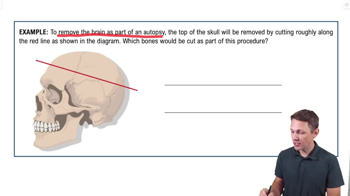
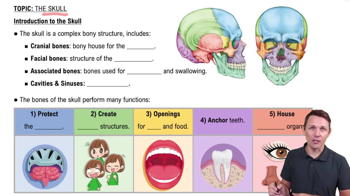
Cranial bones protect the brain; Facial bones form facial features.
Flat bone forming the forehead and superior part of eye sockets.
Flat area between eyebrows on frontal bone; serves as a muscle attachment site.
Ridge above eye socket on frontal bone; a muscle attachment site.
Four regions: Squamous, Tympanic, Mastoid, and Petrous.
Indentation in temporal bone that receives mandibular condyle to form the TMJ joint.
Passageway in temporal bone for carotid arteries supplying 80% oxygenated blood to brain.
Passageway for jugular veins that drain blood from the brain.
Articulate with atlas (C1) vertebra; allow "YES" motion of the head.
Saddle-shaped indentation on sphenoid bone that holds the pituitary gland.
Projection of ethmoid bone serving as attachment for meninges (brain covering membranes).
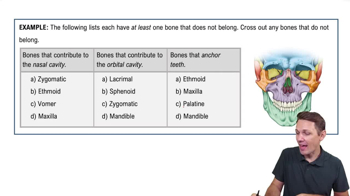
Formed by the perpendicular plate of ethmoid and the vomer bone.
Joint between right and left parietal bones; divides the skull into right and left halves.
Irregular bone holding lower teeth; largest and only freely movable skull bone.
Passageway for nerves and vessels to lower teeth and gums; site for dental anesthesia injection.
Irregular bone forming upper jaw; holds upper teeth and touches all facial bones.
Forms the posterior one-third of the hard palate.
Formed by the zygomatic process of temporal bone (posterior) and temporal process of zygomatic bone (anterior).
Lighten the skull and enhance voice resonance.
Only free-floating bone; attachment site for tongue muscles; important for speech and swallowing.
Soft spots in infant skull made of fibrous membrane; allow skull growth and compression during childbirth.
Closes between 2 to 3 years of age.
Curved structure of ethmoid bone that speeds airflow and cleans inhaled air.